

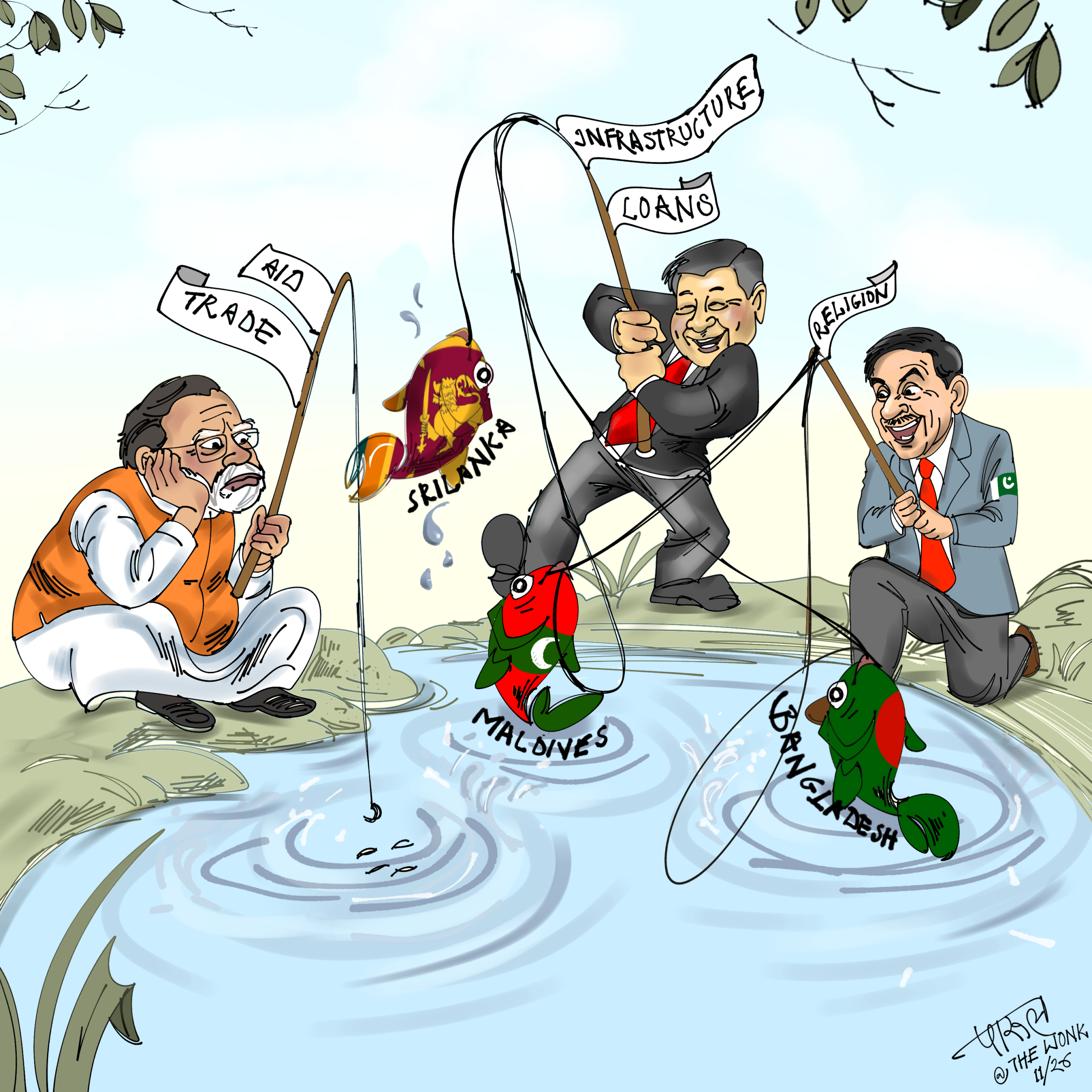
India is recognised as South Asia’s largest power, and this recognition gives the country considerable economic, political, and strategic influence. However, geographical proximity and historical ties don’t necessarily indicate diplomatic goodwill. The recent developments in Sri Lanka, the Maldives, and Bangladesh suggest that India’s relationships with its immediate neighbours require more careful evaluation and management.
These neighbouring countries are engaging more with China, Pakistan, and other external powers. Therefore, India cannot assume its regional influence will remain unquestioned. New Delhi needs to recognise that its neighbours have independent foreign policy priorities and strategic interests. Instead of interpreting Sri Lanka, the Maldives, and Bangladesh’s outreach to rival powers as a diplomatic setback, India needs to reconsider the way it exercises its influence. To maintain its position in the neighbourhood, it requires a more balanced, consultative, and development-oriented foreign policy.
The Maldives-Pakistan Agreements: A Development India Cannot Ignore
One of the most significant recent developments in India’s neighbourhood diplomacy is Maldivian President Mohamed Muizzu’s visit to Pakistan from October 20 to 22, 2026. The visit, which coincided with the 60th anniversary of diplomatic relations between the two countries, resulted in the exchange of 20 Memorandums of Understanding (MoUs) covering several areas of cooperation.
The agreements cover defence cooperation, maritime security, healthcare, education, agriculture, fisheries, tourism, information technology, cybersecurity, civil aviation, and law enforcement. The two countries have also said they intend to increase bilateral trade from about $13.9 million to $200 million over the next two years. Pakistan has additionally offered scholarships and professional training opportunities to Maldivian students.
Although these agreements do not constitute a formal military alliance, their strategic implications deserve attention. In particular, the defence and maritime security MoUs provide Pakistan with opportunities to expand its engagement in the Indian Ocean region.
Pakistan also used the diplomatic engagement to raise its positions on Jammu and Kashmir and the Indus Waters Treaty. However, Muizzu did not publicly endorse these positions during the visit.
India needs to view the development with strategic caution rather than alarm. The Maldives can diversify its international partnerships, but New Delhi cannot afford to overlook the growing diplomatic space that Pakistan is gaining in a country located close to India’s southern maritime boundaries.
The focus must shift to why the Maldives considers expanding its engagement with countries outside India’s immediate diplomatic circle valuable. India must ensure its partnership offers sufficient economic, technological, and strategic benefits to remain attractive.
Sri Lanka: Balancing Strategic Cooperation with Political Sensitivities
Sri Lanka holds a position of extreme importance in India’s Indian Ocean strategy. Its location along major international shipping routes makes it significant for maritime security, trade, and regional connectivity.
Historically, India has maintained close relations with Colombo, providing substantial economic assistance during Sri Lanka’s financial crisis and supporting its recovery after natural disasters. However, Sri Lanka’s foreign policy has also indicated its determination to maintain relationships with multiple international partners, including China.
In September 2026, Defence Minister Rajnath Singh visited Sri Lanka, marking the first visit by an Indian defence minister to the island nation in 38 years. The two countries discussed defence cooperation and regional maritime security. They also exchanged agreements to upgrade Sri Lanka’s air-defence guns and to expand military academic and youth exchanges.
Earlier, in August 2026, Foreign Secretary Vikram Misri visited Colombo, where India and Sri Lanka exchanged agreements involving two Indian rupee-denominated lines of credit worth $250 million and $100 million. These were intended to support railway projects, livestock development, and other priorities.
These initiatives indicate that India recognises Sri Lanka’s importance as a neighbouring country. However, long-term goodwill cannot be established through economic assistance and defence cooperation alone.
India must remain sensitive to Sri Lanka’s domestic political considerations, particularly concerns about sovereignty, economic dependence, and external influence. Its approach should be based on mutual interests rather than expectations of political alignment.
Bangladesh: Political Differences Are Affecting Diplomatic Relations
Since the political disorder of August 2024, which led to the removal of former Prime Minister Sheikh Hasina, India’s relationship with Bangladesh has experienced considerable turbulence. The two countries have disagreed over several issues because of her continued presence in India.
The political transition has also changed the dynamics of bilateral engagement. Bangladesh’s current government has said it is willing to improve relations with New Delhi, but it has also called for a more conducive diplomatic environment. Bangladesh continues to seek Hasina’s extradition, while India has maintained that it is examining the request through the appropriate legal and judicial procedures.
India and Bangladesh share extensive land borders, river systems, trade routes, and energy infrastructure. Their cooperation is particularly important for regional connectivity and the development of India’s northeastern states.
Some positive steps have been taken in this direction. For instance, in October 2026, a joint group working on bilateral trade met in New Delhi for the first time in three years to discuss trade barriers and port restrictions. The two countries are also renegotiating the Ganga Water Sharing Treaty, which expires in December 2026.
However, unresolved political disagreements could undermine these initiatives. India must avoid allowing its relationship with Bangladesh to become overly dependent on its political preferences or past diplomatic relationships. A stable partnership requires engaging with the government in power, respecting Bangladesh’s sovereignty, and being willing to address contentious issues through dialogue.
Why Should India Rebalance its Neighbourhood First Policy?
India’s Neighbourhood First Policy aims to strengthen economic, political, and security relationships with neighbouring countries. Its broader MAHASAGAR vision also emphasises cooperation and collective development across the Indian Ocean region.
However, the effectiveness of these policies depends on how India’s neighbours look at its actions. A country may welcome Indian investment and assistance while simultaneously seeking closer relations with China, Pakistan, or other powers. Such decisions should not automatically be interpreted as hostility towards India.
Three essential reasons that indicate why India needs to reconsider its diplomatic approach are as follows:
1. Respect for strategic autonomy
India’s neighbours are sovereign countries with their own political priorities. Expecting them to consistently align with New Delhi’s strategic interests is unrealistic. India must accept that Sri Lanka, the Maldives, and Bangladesh will continue to diversify their international relationships. Our objective should be to remain a preferred partner, not to become the only partner.
2. Economic engagement must deliver tangible benefits
China’s growing presence in South Asia demonstrates how infrastructure, connectivity, and investment can translate into diplomatic influence. India must compete through reliable project implementation, accessible financing, trade opportunities, and technology partnerships. We must pair financial assistance with projects that deliver visible economic benefits to local communities.
3. Diplomacy must extend beyond political leadership
India’s relationships should not depend exclusively on the government or political leadership in power in neighbouring countries. Stronger connections with businesses, universities, civil society, media, and younger generations can create a more durable foundation for bilateral relations. People-to-people engagement can help sustain goodwill even during periods of political disagreement.
Summing up
India does need to rebalance its foreign policy towards Sri Lanka, the Maldives, and Bangladesh. However, this should not mean abandoning its strategic interests or weakening its security priorities. Instead, it requires a shift from an influence-driven approach towards a partnership-oriented one.
The Maldives-Pakistan MoUs show that India’s neighbours have alternatives and will pursue them when they see opportunities. Sri Lanka’s diplomatic balancing and Bangladesh’s changing political relationship with New Delhi reinforce the same lesson.
India’s regional leadership ultimately depends less on its ability to discourage neighbouring countries from engaging with external powers and more on its ability to remain their most dependable partner. It will be essential to respect sovereignty, deliver economic benefits, address disagreements through dialogue, and maintain political consistency.