

The American H-1B visa programme has recently become a topic of intense debate over immigration, employment, and the future of the US workforce. While supporters see it as an important way to attract global talent, critics argue that it enables companies to exploit foreign workers and suppress American wages. Indian professionals, in particular, who account for a significant share of H-1B beneficiaries, find themselves caught between these conflicting views.
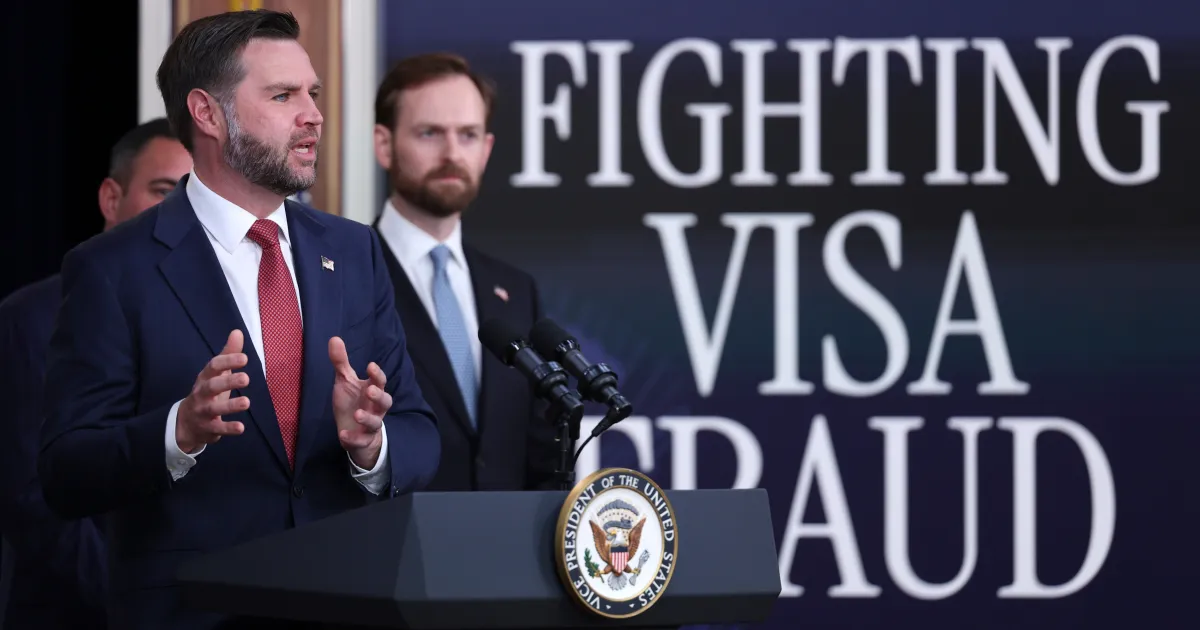
Since the U.S. Vice President, JD Vance, has described H-1B workers as ‘indentured servants,’ the debate has taken a controversial turn. His remarks have raised questions about the dependence of foreign professionals on their employers and whether the visa system leaves them vulnerable to exploitation. But is this comparison justified, or is it part of the MAGA movement’s wider opposition to foreign workers?
Why Are H-1B Workers Being Called ‘Indentured Servants’?
In October 2026, JD Vance accused American companies of exploiting the H-1B programme to replace domestic workers with cheap foreign labour, sparking the controversy and giving it fresh momentum. He argued that some employers use the visa system to bring in foreign professionals who have little choice but to accept unfavourable working conditions because their immigration status depends on their employment.
On October 17, 2026, Vance defended his remarks during a CBS News town hall, saying his criticism was directed at companies and the immigration system rather than H-1B employees themselves. He acknowledged that his choice of words may have been imperfect but maintained that the underlying concern was valid.
The term ‘indentured servants’ has a specific historical meaning. It refers to people who entered into contracts to work for a specific period, often to repay debts or cover the cost of their passage to another country. While indentured labour isn’t the same as slavery, workers often had limited freedom and faced exploitative conditions.
Vance’s use of the expression ‘indentured servants’ suggested that some foreign professionals are effectively tied to their employers because if they lose their jobs, their ability to remain in the U.S. can be at risk.
The Indian Ministry of External Affairs (MEA) criticised the terminology, describing it as ‘unwarranted’ and ‘deeply offensive.’ The remarks were particularly sensitive given the significant contribution Indian professionals have made to the American economy.
How Does the H-1B System Work, and Why Are Indians Affected?
The H-1B visa category allows U.S. employers to recruit foreign professionals for specialised jobs that require technical knowledge or advanced qualifications. These include positions in information technology, engineering, finance, healthcare, and scientific research. The visa is generally granted for up to three years and can be extended to a maximum of six years, subject to certain exceptions.
The largest group of H-1B beneficiaries is Indian professionals. The USCIS data for FY 2024 suggests that approximately 71% of approved H-1B petitions were for people born in India. This reflects the strong presence of Indian professionals in the American technology and business sectors.
However, the visa’s employer-sponsored nature creates certain challenges. An H-1B holder cannot simply move to another job without the prospective employer filing the required immigration petition. The H-1B portability provision allows eligible employees to change employers, but if they lose the job, it can create considerable uncertainty.
Generally, a grace period of up to 60 days is granted to workers who lose their jobs. This may extend until the end of their authorised stay, whichever is shorter, to find another qualifying employer or explore other immigration options. This can be a difficult situation for someone who has spent years building a career in the U.S.
The pressure is not limited to employment. Many Indian professionals have families, financial commitments, and children studying in American schools. Some have also spent years waiting for their employment-based Green Card applications to progress. These factors can make leaving an employer or returning to India a difficult decision.
This does not mean all H-1B employees face exploitation. However, the system can create an imbalance of power between employers and foreign professionals, particularly when workers are worried about their immigration status.
H-1B Policy Developments Amidst MAGA Politics
The Trump administration has consistently expressed that the H-1B programme has been misused by companies to hire foreign professionals at lower wages and displace American workers. This position fits into the broader MAGA agenda of prioritising domestic employment and tightening immigration rules.
The administration introduced several measures to address what it describes as widespread misuse of the programme.
One of the most controversial of these measures was President Donald Trump’s September 2025 announcement of a $100,000 fee for certain new H-1B petitions involving workers outside the U.S. The measure was intended to discourage companies from using foreign workers as a cheaper alternative to American employees.
However, the policy faced legal challenges. In June 2026, a federal court blocked the fee, and on September 30, 2026, a second federal judge ruled against its implementation. Although the White House extended the underlying proclamation until September 2027, court orders have prevented the government from collecting the payment. As of today, the legal dispute remains unresolved.
On October 8, 2026, another significant development occurred when the U.S. Department of Labor suspended eight major technology companies from the Permanent Labour Certification (PERM) programme. These included Indian IT companies Tata Consultancy Services (TCS), Infosys, Wipro and HCLTech, along with Microsoft, Adobe, Cognizant, and Capgemini.
PERM is an important step in the employment-based Green Card process. Under the programme, employers must generally demonstrate that qualified American workers are unavailable for the position and that hiring a foreign professional will not adversely affect the wages and working conditions of U.S. employees.
As per the suspension order, the Department of Labor will no longer accept new applications or process pending PERM applications involving these companies. The move could permanently delay residency plans for eligible foreign employees, including Indian professionals who have been working in the U.S. for several years.
India’s Ministry of External Affairs responded to the issue by clarifying that the suspension of PERM applications would not automatically affect existing H-1B visas or the status of their holders and dependents. However, it did acknowledge that the Green Card process for eligible employees could be affected.
The ministry also objected to Vance’s description of foreign professionals, calling the terminology deeply offensive because of its historical and colonial associations. India’s technology industry body, NASSCOM, similarly emphasised that skilled talent mobility and immigration are separate issues and should not be viewed through the same lens.
These developments indicate that the debate is no longer limited to political statements. It has begun to affect the immigration pathways available to skilled foreign professionals.
Are Indian H-1B Visa Holders Really ‘Indentured Servants’ or Trapped Workers?
The comparison between H-1B professionals and indentured servants is debatable. Historically, indentured labour involved contractual arrangements that often severely restricted workers’ freedom. Many such individuals had little control over their working conditions and could face harsh consequences for leaving before completing their contracts.
Modern H-1B professionals operate under a different legal framework. They receive salaries, have employment rights, and can change employers under specific immigration provisions. They are not legally bound to serve one company indefinitely.
However, Vance’s concerns cannot be entirely dismissed. An employer-sponsored visa can make foreign workers hesitant to challenge unfair treatment or leave an unsatisfactory job. Their decisions can be influenced by the risk of losing their job and having to leave the country.
At the same time, there’s a need to closely examine the argument that foreign professionals are systematically taking American jobs. The H-1B programme was created to help U.S. businesses access specialised skills. International professionals contribute to research, technology development, entrepreneurship, and economic growth, but their presence doesn’t automatically mean that an American worker has been displaced.
The U.S. government’s challenge is to prevent companies from misusing the programme without making skilled immigration unnecessarily difficult. The concerns can be addressed through stronger wage protections, fair recruitment practices, better employee mobility, and action against fraudulent sponsorship arrangements.
Ultimately, Indian H-1B holders are not indentured servants in the historical or legal sense of the term. That said, the visa system can leave some workers dependent on their employers, creating conditions where exploitation is possible.
MAGA’s emphasis on protecting American jobs is a political position that reflects concerns about employment, wages, and immigration. But describing foreign professionals in historically loaded terms risks turning a legitimate labour-market discussion into a broader debate about immigrants and their place in American society.
The issue also has wider economic implications for India and the U.S. Indian professionals contribute to American businesses, while U.S. companies benefit from access to India’s skilled workforce. To maintain this relationship, the U.S. must balance domestic employment priorities with the need for international talent.
Therefore, the real question isn’t whether H-1B holders should be labelled indentured servants. It is whether the U.S. can reform its immigration system to protect both American workers and foreign professionals without undermining the economic benefits of skilled talent mobility.