

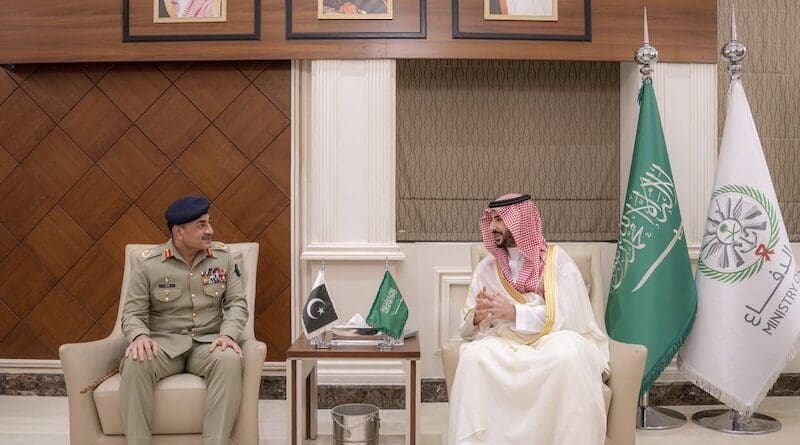
Pakistan is discovering that signing a defence agreement is easier than managing the war it may eventually be asked to join. The Makkah Joint Defence Agreement, signed by Pakistan, Saudi Arabia and Türkiye on August 7, 2026, was presented as a commitment to collective security. Its central provision is straightforward: an armed attack on one member is to be treated as an attack on all three. But the conflict surrounding Saudi Arabia has exposed a difficult question. Can Pakistan honour its commitment to Riyadh while maintaining a workable relationship with neighbouring Iran, which has long been associated with Yemen’s Houthi movement?
The question is no longer theoretical. Houthi missile and drone attacks on Saudi territory, threats to critical infrastructure and pressure around the Red Sea have placed the agreement under its first serious real-life test. Islamabad has condemned the attacks and promised support for Saudi security. Yet, Pakistan’s own foreign policy requires it to avoid an open confrontation with Iran. Its challenge is to demonstrate that collective defence does not automatically mean an unlimited military commitment.
The ‘Makkah Accord’ emerged from a changing West Asian security environment. Saudi Arabia has spent years trying to reduce its exposure to regional conflicts while protecting its energy infrastructure, trade routes and political standing. The attacks on Saudi oil facilities in September 2019, widely attributed by Saudi Arabia and the United States to Iran, exposed the vulnerability of even heavily defended infrastructure. The war in Yemen had already shown how missiles, drones and relatively inexpensive weapons could threaten a much stronger military power.
The latest escalation adds another layer. The Houthis have threatened Saudi territory and maritime traffic around the Red Sea and the Bab el-Mandeb Strait, one of the world’s important shipping chokepoints. The consequences extend beyond the Gulf. Disruption here can affect energy shipments, insurance premiums, freight costs and trade between Europe and Asia. The security of Saudi Arabia is therefore not merely a bilateral concern; it is tied to the stability of international commerce.
For Riyadh, the Makkah Accord offers a stronger political signal and a framework for collective deterrence. For Pakistan, however, it creates a difficult strategic obligation. Islamabad has deep military ties with Saudi Arabia, which has provided financial support at critical moments. Millions of Pakistani citizens live and work in the Kingdom, making Saudi stability a direct economic and human concern. Pakistan cannot simply distance itself from an ally facing repeated attacks.
But Iran is not a country Pakistan can afford to treat as an expendable relationship. The two share a long border, security concerns in Balochistan, trade interests and a history of diplomatic engagement despite recurring tensions. In January 2024, Iran and Pakistan exchanged cross-border strikes against militant targets, followed by diplomatic efforts to restore relations. That episode demonstrated how quickly a local security dispute can become a national crisis. A direct Pakistani military campaign against Iranian-linked forces in Yemen could create a much wider problem.
The historical record offers a warning. In 2015, when Saudi Arabia launched its military intervention in Yemen, Pakistan’s Parliament called for neutrality in the conflict while supporting the Kingdom’s territorial defence. Islamabad was reluctant to enter a war that could inflame sectarian divisions at home, strain relations with Iran and expose Pakistani troops to an open-ended commitment. That decision reflected a basic geopolitical reality: close defence ties do not remove the need to calculate national interests.
The present situation is more complicated because the Makkah Accord gives collective defence a formal framework. Yet it does not automatically settle the question of what military action each member must take, where it must operate or whether every attack by a non-state armed group requires offensive retaliation. Those decisions depend on the agreement’s implementation, consultations among its members and the circumstances of the attack.
Pakistan’s public position has so far reflected that distinction. Islamabad has condemned Houthi attacks and reaffirmed its commitment to Saudi sovereignty. At the same time, its Foreign Office has said that the Makkah alliance is defensive and that its forces would not cross into Yemen to launch attacks against the Houthis. The precise nature of any operational support must therefore be distinguished from unverified claims that Pakistani aircraft or troops are conducting offensive operations.
This distinction could become the basis of a workable strategy. Pakistan could help protect Saudi territory, strengthen air defence, improve intelligence sharing and secure critical infrastructure without directly joining a campaign inside Yemen. It could also press Iran to use its diplomatic influence to reduce Houthi attacks, while making clear that threats to Saudi civilians and infrastructure cannot be accepted as normal regional politics.
Indeed, Pakistan’s ability to communicate with Tehran may be one of its most useful strategic assets. If Islamabad abandons diplomacy and becomes a direct participant in a broader anti-Houthi campaign, it risks losing that access. Conversely, if it invokes mediation to avoid every meaningful obligation to Saudi Arabia, it risks weakening the credibility of the defence pact. Neither extreme serves Pakistan’s long-term interests.
There is also a domestic dimension. Pakistan has a diverse population, including a substantial Shia community, and any conflict framed as a sectarian contest could deepen internal divisions. A prolonged military commitment in Yemen would also compete for resources with Pakistan’s own security requirements. An alliance that is meant to strengthen national security should not inadvertently create fresh vulnerabilities at home.
Türkiye’s position will matter as well. Its participation gives the accord greater regional weight, but the three partners have different strategic priorities and different appetites for military risk. The agreement’s credibility will depend less on declarations of solidarity than on whether its members can agree on a clear, proportionate and sustainable response to threats.
For Pakistan, the test is therefore not whether it can choose Saudi Arabia over Iran or Iran over Saudi Arabia. Geography, economics and security make such a binary choice unrealistic. The real test is whether Islamabad can define the limits of its commitments, defend an ally against genuine aggression and preserve diplomatic channels with a powerful neighbour.
The Makkah Accord may strengthen deterrence if its members make their responsibilities clear and avoid giving adversaries reasons to widen the conflict. But if it becomes a vehicle for an open-ended campaign in Yemen, it could draw Pakistan into a confrontation whose costs extend far beyond the battlefield.
A defence pact can promise solidarity. It cannot remove geography, history or national interest. Pakistan must now prove that collective defence and regional diplomacy can coexist. If it fails, the price may be more than a damaged relationship with Tehran: it could be the loss of its ability to act as a bridge in a region that desperately needs one.