

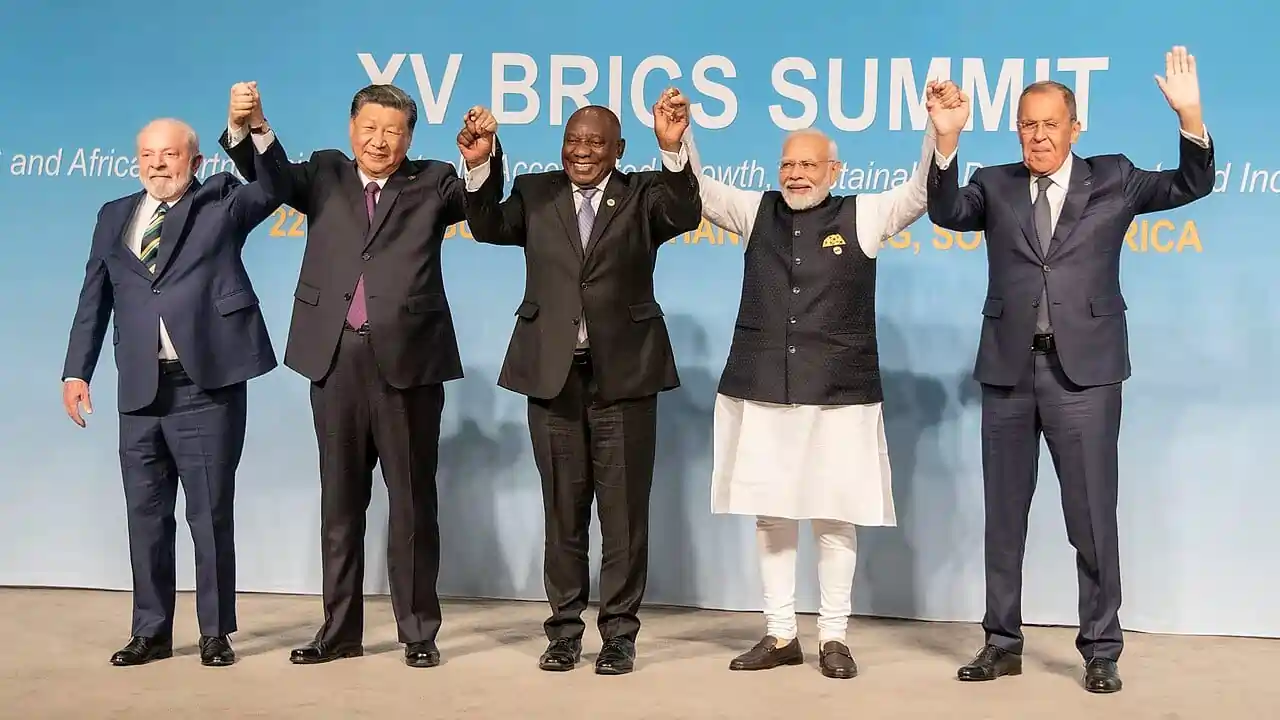
Prime Minister Narendra Modi’s declaration that “BRICS under India’s chairmanship will work together to build a more inclusive world order” is more than a simple routine diplomatic statement at the forefront of the 18th BRICS Summit. Scheduled to be held in New Delhi on 12–13 September 2026, the summit embodies a great opportunity for India to steer the agenda of one of the world’s most influential groupings of emerging economies at a time when the international order is undergoing profound change, in this era of conflicts if India can strongly position itself as an envisionary leader it would certainly be a remarkable achievement for the country. Rather than merely preparing to host another multilateral meeting, India is attempting to project a broader diplomatic vision centred on reforming the utmost global governance, fortifying multilateral cooperation, and further deepening the voice of the Global South.
The underlying principle of BRICS is neither a military alliance like NATO nor an economic union comparable to the European Union. It is an intergovernmental platform through which major emerging economies constantly coordinate on several contemporary issues, politics, economics and developmental goals. When it was established, Brics comprised Brazil, Russia, India and China, the grouping became BRICS with South Africa’s inclusion in 2010. In recent years, its membership has expanded further to include countries such as Egypt, Ethiopia, Iran, the United Arab Emirates and Indonesia, dramatically increasing both its geographical reach and geopolitical salience.
The origins of BRICS lie in the reconfiguring balance of global economic power. While some of the major institutions such as the United Nations Security Council, the International Monetary Fund (IMF), the World Bank and other pillars of the post-Second World War international order continue to extensively mould the global governance, many developing nations have long argued that these institutions no longer adequately reflect the interim realities of the twenty-first century. Countries such as India, Brazil and South Africa have predominantly maintained that their growing economic and demographic significance should be directly matched by a greater representation in the international decision making process. BRICS emerged as a platform through which these countries could genuinely coordinate their positions, advocate their reforms in global governance, strengthen South-South cooperation and create a few new mechanisms for the emergence of the New Development Bank (NDB).
Contrary to a prevailing misconception which has existed for a long span of time, BRICS does not legally position itself as an anti-Western bloc. Rather, it advocates the emergence of a multipolar world order. A unipolar system generally concentrates on global influence in the hands of a single dominant power, whereas a multipolar order foresees multiple centres of influence participating in international decision-making. It is within this framework that Prime Minister Modi’s reference to an “inclusive world order” should be grasped. The phrase exemplifies India’s strong belief that influential economies deserve a more robust voice in shaping global institutions and policies without endeavouring to swap one dominant power with the other.
India’s role as the Chair of BRICS in 2026 is therefore especially considerable. Under the grouping’s rotating chairmanship, each member country assumes responsibility for hosting the Leaders’ Summit, setting the upcoming annual theme, coordinating ministerial and working-group meetings, steering discussions and enhancing consensus among members. The Chair does not become the leader of BRICS; all member states remain balanced. Rather, the chairmanship provides an avenue to shape the priorities of the forum of Nations during that particular year.
Subsequently, India is hosting the 18th BRICS Summit because it currently holds the chairmanship; not the other way around. Brazil chaired BRICS in 2025, hosting the 17th BRICS Summit in Rio de Janeiro on 6–7 July 2025, after which the rotating presidency passed to India.
India has chosen to interpret its presidency through the overarching theme “Building Resilience, Innovation, Cooperation and Sustainability (BRICS).” These four pillars reflect New Delhi’s attempt to provide a distinctive ethos to its chairmanship while staying faithful to its broader diplomatic agendas. Resilience focuses on strengthening countries against pandemics, climate-related disasters, cyber threats, supply-chain disruptions and financial shocks. Innovation directlydraws attention to cooperation in areas such as artificial intelligence, digital public infrastructure, fintech and newly prominent technologies. Cooperation underscores India’s emphasis on dialogue and consensus-building despite political differences among members. Sustainability unfolds climate action, renewable energy, food security and long-term development.
The geopolitical importance of India’s presidency extends way beyond the September summit itself. Throughout the year, New Delhi has brought together a huge series of preparatory meetings involving several foreign ministers, finance ministers, the national security advisers, the sherpas as well, business councils and specialised working groups. These meetings have very promptly addressed issues ranging from disaster risk reduction and transport cross border connectivity to intense agricultural initiatives, health, digital economy, energy cooperation and anti-drug coordination. Rather than waiting for the Leaders’ Summit, India has been systematically shaping the agenda through prolonged and serious diplomatic engagement.
These negotiations also reveal the nuanced layers of India’s task. BRICStoday is far more wide ranging than it was a few decades ago. India and China continue to have unresolved and pending border disputes still. Iran faces several regional and international challenges. Russia’s strategic priorities completely differ from those of Brazil and South Africa. The expansion of BRICS has significantly increased its global influence, but it has also made consensus building materially more rigorous and demanding. This was totally evident during the BRICS Foreign Ministers’ Meeting in New Delhi, where conflicting differences over developments in West Asia hindered the adoption of a joint declaration, leading India to issue a Chair’s Statement instead.
The historical roots of BRICS can also be comprehended through the broader periphery of colonialism and Western dominance. Colonial discourse has often been anchored in the notion of a ‘civilising mission’, the belief that European powers had an accountability to civilise non-Western societies. Literary works such as Joseph Conrad’s Heart of Darkness continue to generate scholarly debates on colonialism, imperial representation and great power. It is against this historical backdrop that many advancing economies today argue for a more emblematic global governance structure.
Against this backdrop, Modi’s repeated emphasis on dialogue, multilateralism and inclusiveness acquires a much greater significance. His remarks are not directed merely towards strict and severe confrontation but towards recognising those essential areas where cooperation remains possible despite the several geopolitical disagreements which have often existed. This stance is directly aligned with India’s long-standing policy of strategic autonomy, under which New Delhi maintains productive relations with countries across rivaling geopolitical blocs, including the United States, Europe, Russia, Japan and partners across the Global South.
India’s stewardship also illustrates continuity with the diplomatic themes it had advanced during its G20 Presidency in 2023. The core concepts such as reform of multilateral institutions, inclusive development, digital public infrastructure and the growing importance of the Global South continue to be incorporated chiefly in India’s BRICS agenda. While the G20 and BRICS are distinct institutions with quite different memberships and mandates, there is a noticeable continuity in India’s diplomatic messaging across both these respective platforms.
Beyond the internal coordination, there lies another important update, India has also sought to make BRICS more open to global engagement. Invitations are extended to outreach partners and regional organisations underscore New Delhi’s effort to cultivate reforms with countries beyond the group’s formal membership. Such diplomatic efforts reflect India’s broader objective of centrally positioning BRICS as a platform that strongly highlights the aspirations of a wider developing world rather than a closed geopolitical consortium.
The significance of India’s BRICS presidency is elevated by the current international environment. The Russia–Ukraine conflict, growing strategic competition between the United States and China, severe instability in parts of West Asia, and the frequent disruptions to global supply chains have rekindled calls for a broader and better representative and flexible international order. At the same time, BRICS has also decided to expand its membership, increasing both its economic weight and political influence. For many countries in the Global South, the grouping has typically developed as an important platform to push for reforms in global governance and to diversify partnerships. India’s chairmanship, therefore, comes at a moment when expectations from BRICS certainly extend beyond economic cooperation to minutely crafting debates on the future of multilateralism and international development.
India’s current presidency also builds upon its earlier stewardship of BRICS. Having presided over the grouping in 2012, 2016 and 2021, New Delhi has unwaveringly reiterated reform of multilateral institutions, sustainable development, counter-terrorism, digital cooperation and greater representation for developing countries. The 2026 presidency captures continuity with these earlier priorities while responding to a more complex geopolitical environment shaped by BRICS strengthening and growing global fragmentation.
In essence, the September summit is about far more than just an ordinary ceremonial diplomacy. It clearly represents a test of India’s ability to guide an expanded and increasingly influential BRICS through a period signaled by geopolitical fragmentation, strategic competition and calls for reform of global governance. Whether India succeeds or not will depend less on the declarations endorsed in New Delhi than on its ability to foster convergence of views among diverse member states while fostering a vision of multilateral cooperation that remains relevant in a progressively complex international order. PM Modi’s call for a more inclusive world order is, therefore, not solely the slogan of a summit, but it is the central diplomatic message India hopes its BRICS presidency will leave behind.
Article by Sruti Bhaumik