

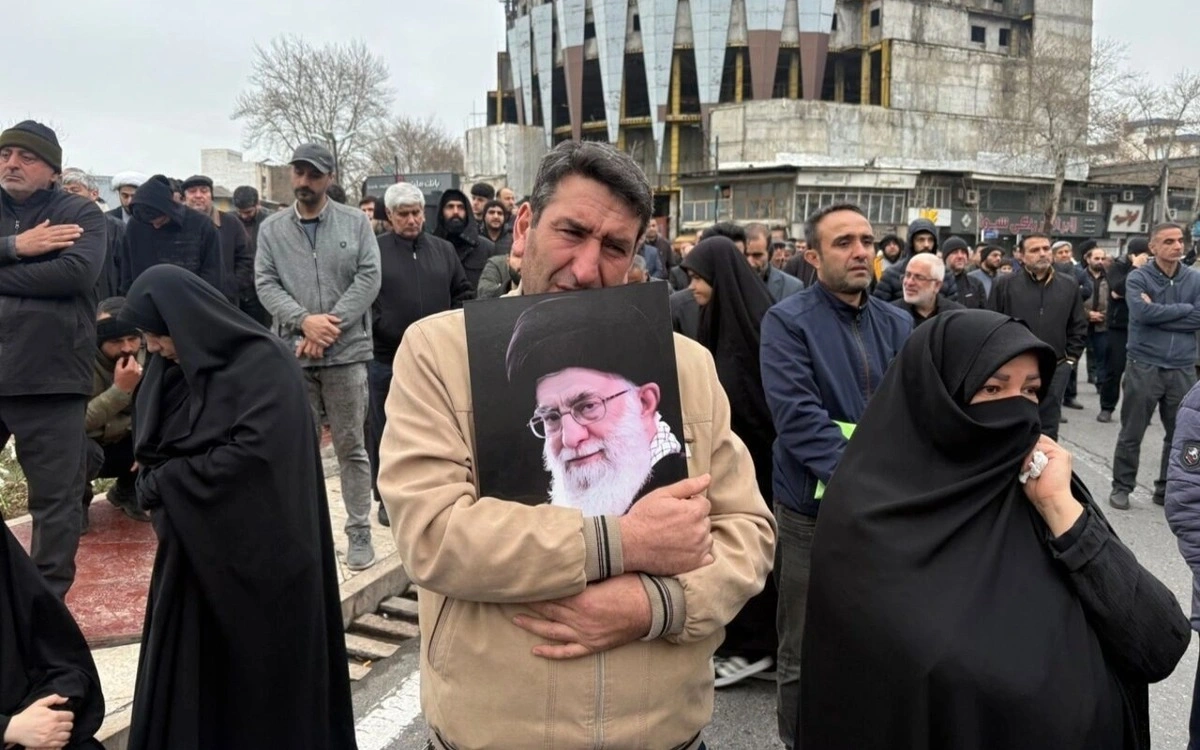
When the news broke that Iran’s Supreme Leader, Ayatollah Ali Khamenei, had been killed in coordinated strikes attributed to Israel with reported U.S. backing, the shock was like an immediate bullet. Thereafter the Iranian state media confirmed his death and declared a forty days long mourning period. Across the entire region, retaliation followed very swiftly. What we are witnessing today is not merely another episode in a long rivalry; yes, you heard it right!
It is a structural rupture in one of the most centralized political systems in the Middle East.
In Iran, the Supreme Leader is not “symbolic”. He stands above the presidency, commands the armed forces, oversees the Revolutionary Guard, shapes foreign policy, and influences the complete nuclear direction. Removing such a figure through military action shifts more than leadership; it has literally shaken the architecture of power, which almost feels as if power has suddenly collapsed.
But before calling this as a mere “new beginning,” we must understand that this moment did not emerge overnight, there were a series of incidents and incomplete negotiations which ultimately led to this event.
A Conflict That Has Been Waiting to ‘Explode’!
Iran and Israel have existed in sustained hostility since the 1979 Iranian Revolution. What followed was not open war but controlled confrontation; a kind of shadow struggle through proxies, rhetoric, intelligence, disturbed narratives and deterrence. Iran extended support to Hezbollah, Hamas, militias in Iraq and Syria, and the Houthis. Israel responded with a doctrine of pre-emption, especially concerning missile expansion and the vast nuclear enrichment. Each side has often called most of its actions defensive. Each side saw the other as a prime source of ‘existential threat’.
This is where the security dilemma becomes very crucial. When one state increases its defensive capacity, the other reads it as preparation for aggression. Thus, mistrust accumulates slowly, seldom like pressure beneath the tectonic plates. But eventually, as the time passes, friction produces rupture.
The Glass House PrincipleThere is an old proverb: ‘people who live in glass houses should not throw stones’.
In mere geopolitical terms, this translates into a simple principle; a state facing internal unrest must tread carefully in external confrontation.
Iran in the few recent years has faced huge economic strain, sanctions pressure, and domestic dissatisfaction. When the internal cohesion drastically weakens, the external conflict becomes way more riskier. History repeatedly shows that empires rarely collapse solely from foreign attack; internal fractures often accelerate their unfortunate decline.
The fall of powerful systems has followed this pattern before. The Soviet Union did not dissolve because of one decisive strike. It weakened gradually, economically, politically and structurally until the leadership transitions and systemic strain altered the global balance of power. When Soviet authority eroded completely, the geopolitical center shifted, and the United States emerged dominant in the post-Cold War hierarchy. Power transitions are rarely sudden. They are often products of cumulative percussion.
The question now is whether this moment represents such a shift or merely an escalation within an existing balance.
Why Does the Strike Change the Equation?
Airstrikes of this magnitude are not impulsive decisions at all!!!! They involve months of intelligence gathering, strategic planning, and diplomatic calculation to act in this manner. From Israel’s perspective, eliminating the highest node of Iranian decision-making may have been viewed as an altering deterrence logic.
From the United States’ perspective, long-standing security commitments to Israel and concerns regarding Iran’s nuclear trajectory shape involvement. Iran’s retaliation across the region clearly portrays that escalation has already crossed into a new phase. Missile exchanges, drone activity, airspace closures, and Gulf anxieties demonstrate that this conflict is no longer contained to bilateral hostility.
The Middle East’s strategic importance amplifies every shock. Oil mostly flows through the Strait of Hormuz. Maritime routes shape global trade, isn’t it? Energy markets react instantly to fragility. No regional escalation remains regional for too long.
The Dubai / Gulf Region Spillover
The escalation did not remain geographically confined to one particular region. Missile interceptions and debris incidents were reported across parts of the Gulf, including near urban centers in the United Arab Emirates. While not direct targets of the confrontation, such spillover intensified regional anxiety and highlighted how rapidly bilateral hostilities can widen into multi-state instability, which can dismantle the central proportion of global politics. In a region densely interlinked by airspace, trade, and energy routes, even indirect exposure generates strategic tremors throughout.
Leadership Transition and Strategic Uncertainty
Iran’s constitutional mechanism now activates to prevent a power vacuum. The Assembly of Experts will determine the next Supreme Leader. This transition is not ceremonial, it will influence nuclear posture, proxy strategy, and diplomatic receptiveness. History shows that leadership change can either harden ideological lines or recalibrate strategy. After long standing rulers exit, the political systems often enter periods of negotiation which might affect internally and externally as well. The outcome depends not only on who succeeds but on how consolidated Iran’s internal power networks remain.
War or Controlled Escalation?
Despite the intensity of current exchanges, a prolonged full-scale regional war remains very uncertain. Iran faces economic limitations, the entire world is aware of this. Israel traditionally favours decisive operations over extended multi-front conflict. Gulf states have always prioritized stability first. The United States historically seeks containment rather than open-ended engagement.
More likely is the concept of “calibrated escalation”; a sharp retaliation, strategic signaling, back-channel diplomacy, and gradual cooling. But the fear of miscalculation remains as one of the greatest dangers.
Escalations of this magnitude remind us that geopolitical rivalries are rarely abrupt. They are layered with memory, mistrust, and long term calculation. When thresholds are crossed, the consequences extend beyond the immediate actors, reshaping regional psychology and security stabilization norms.
A Moment of Strategic Recalibration
Power struggles define the Middle East. Iran seeks influence, meanwhile Israel seeks deterrence dominance. The United States seeks strategic stability under its umbrella. And the Gulf states seek survival and economic continuity. This event may not immediately redraw the international geopolitical borders. But it has already started to alter the thresholds of the existing world map. The targeting of a sitting Supreme Leader introduces a precedent that shifts the psychological dimension of deterrence.
Under Iran’s constitutional framework, when the Supreme Leader’s position becomes vacant, an interim governing arrangement facilitates institutional continuity while theAssembly of Experts convenes to select a successor. The choice of the next leader will significantly influence Iran’s nuclear posture, regional strategy, and diplomatic structural progression.
Whether this becomes a turning point akin to past global power transitions or simply another chapter in controlled rivalry will certainly depend on the upcoming few weeks. History teaches one coherent lesson: power does not dissolve quietly. It either consolidates or it reorients.
And the Middle East now stands at that uncertain edge.
In Lord of the Flies by William Golding, we witness how the desire for power gradually turns children against one another. What begins as an attempt at order under Ralph slowly descends into rivalry, fear, and violence, until the struggle for dominance overrides morality itself. Power, once contested, reshapes the very structure of the island’s society. In a very similar way, the political power in the real world is never static; it can alter maps, alliances, and psychological balances overnight.
No one anticipated that a central leader would suddenly disappear from the arena of international politics, followed immediately by a 40 day mourning period and regional tremors. A conventional escalation or controlled conflict might have been expected, but not this abrupt rupture. Just as Golding shows how authority, once destabilized, unleashes chaos, geopolitical power too can redefine entire systems in a single unexpected moment.