

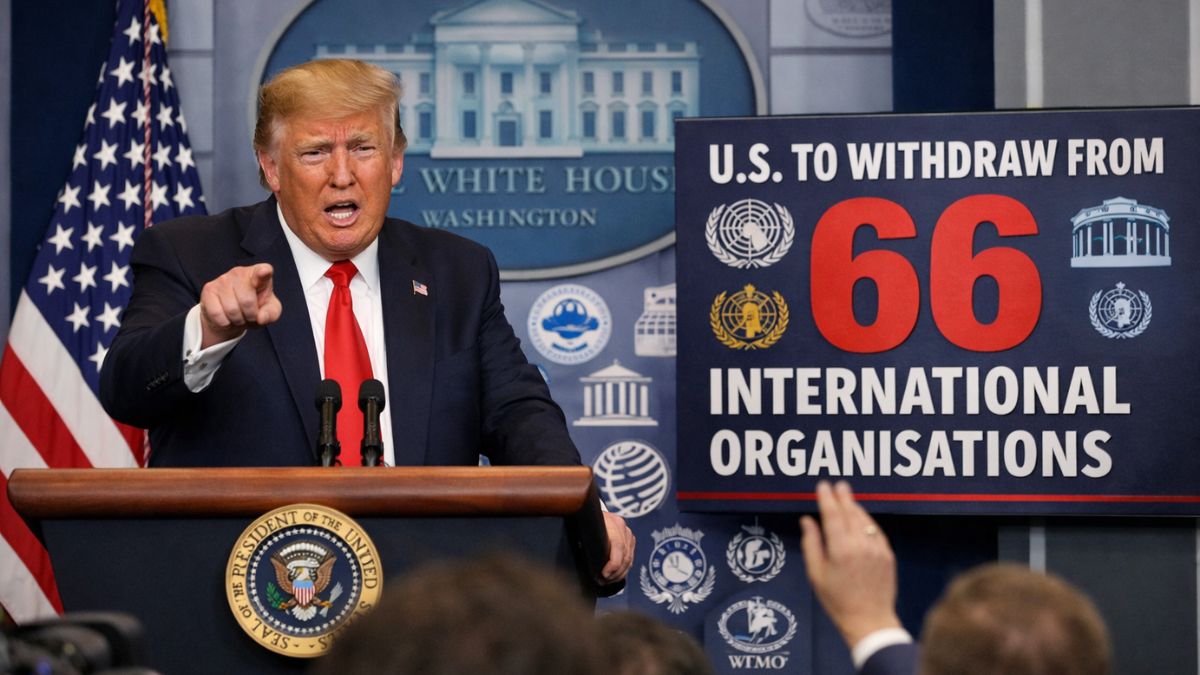
In the early months of 2026, the United States has dramatically shifted its approach to international organisations. Under the current administration, the US has announced or executed withdrawals from numerous international bodies, treaties, and multilateral agreements. This historic shift has broad implications for global governance, international cooperation, diplomatic influence, and global stability.
This article examines why the United States is withdrawing from these organisations, the major areas affected, and how this step is changing the global order. It also assesses both the intended goals and unintended consequences of such a significant transformation in US foreign policy.
The US Withdrawal – An Overview
On January 7, 2026, the White House announced the withdrawal of the United States from 66 international organisations. This includes the UN entities, non-UN bodies, and multilateral systems. This decision was formalised through a Presidential Memorandum titled “Withdrawing the United States from International Organisations, Conventions, and Treaties that are Contrary to the Interests of the United States.” It directed all executive departments to end participation and funding in organisations that no longer serve American interests.
The list includes 31 UN-linked bodies and 35 non-UN organisations that cover a wide range of policy areas, including climate action, human rights, global development, environmental governance, and energy cooperation.
These exits build on earlier retrenchments under the current administration. For example, the US had notified its departure from the World Health Organisation (WHO) in 2025 and also renewed withdrawal notifications to other agencies.
The moves represent one of the sharpest departures from multilateral engagement in US history. They mark a shift from long-standing commitments to international cooperation toward a more sovereignty-centred, bilateral, and unilateral approach.
Reasons the US is Withdrawing from International Organisation
For a better understanding of the withdrawal and its impact on the global order, it is vital to decode the logic behind the shift. Let’s evaluate the ideological and strategic drivers:
1. Sovereignty and “America First” Policy
The Trump administration has often described international organisations as restrictive on US independence. Officials argue that many global institutions promote a “globalist agenda” that reduces America’s control over its own decisions and forces policies that do not match domestic priorities.
2. Perceived Financial Burden
The United States has been the largest or a major contributor to many international agencies. Washington claims that it bears a disproportionate share of the financial burden while receiving limited influence over agenda-setting and outcomes.
3. Institutional Bias and Geopolitical Competition
Another reason for the withdrawal is a belief that international organisations have become arenas where US rivals, particularly China, exert influence. American officials have accused bodies like the WHO of being susceptible to political interference and have used similar language in justifying broader disengagement.
4. Domestic Politics and Strategic Priorities
Domestic political currents, especially from sections sceptical of internationalism, have increased pressure to disengage. The administration’s strategic focus is now tilted toward strengthening domestic infrastructure, military readiness, and bilateral alliances rather than multilateral frameworks.
Key Organisations Affected by the US Withdrawal
While the US has announced its sweeping retreat from several entities, some have attracted global attention because of their symbolic or operational significance.
1. Climate and Environmental Bodies
The United States withdrew from the UN Framework Convention on Climate Change (UNFCCC), the foundational treaty for global climate negotiations and the Paris Agreement framework. Related bodies, such as the Intergovernmental Panel on Climate Change (IPCC) and the International Renewable Energy Agency (IRENA), have also lost US participation. These exits indicate a withdrawal from international climate leadership and could complicate collective efforts to meet emissions and adaptation goals.
2. Social and Development Agencies
US withdrawal is also visible in the UN Women, UN Population Fund (UNFPA), and other social agencies. As a result, there is an impact on gender equality, reproductive health, and demographic research initiatives. Such moves are likely to diminish global efforts in areas where US funding and diplomatic influence have historically been significant.
3. Cultural and Educational Bodies
The US has again moved to exit UNESCO, an agency dedicated to education, science, and culture, citing ideological disagreements and alleged bias. This follows earlier cycles of withdrawal and re-entry.
4. Health and Humanitarian Institutions
The World Health Organisation (WHO) withdrawal, first ordered in January 2025, represents a significant shift in global health governance. It reduces US influence on pandemic preparedness, disease surveillance, and worldwide health standards.
Immediate Effects of the US Withdrawal
Here’s how the withdrawal will affect global order immediately:
a) Funding Gaps
US funding has supported many global programmes in the past. Its withdrawal risks creating financial shortfalls in areas like disease control, humanitarian aid, climate finance, and gender equity initiatives. This could force organisations to scale back activities or seek new donors. For example, other nations or regional blocs might need to fill funding gaps in UN agencies and development programmes, altering the balance of influence within these bodies.
b) Diplomatic and Negotiating Power
US withdrawal reduces its ability to shape international norms and negotiations from within. Whether in climate fora or human rights councils, Washington’s absence may reduce its leverage to advocate for its policy preferences. Analysts also warn that other strategic competitors may try to fill this gap.
c) Operational Disruption
There may be logistical challenges for agencies dependent on US technical expertise and personnel. Reduced information-sharing and coordination can weaken collective responses to global crises like pandemics, climate events, and transnational crimes.
Broader Implications for the Global Order
The withdrawal will have the following broader implications in the long term:
1. Weakening of Multilateralism
The US retreat weakens the idea of countries working together to solve global problems, which was a key feature of the international system in the 20th century. As faith in multilateralism, the belief that global challenges need joint action, declines, rival powers may gain confidence, and other countries may look for different ways to manage global affairs.
2. Power Shifts: China, EU, and Global South Dynamics
If the US reduces its engagement globally, the space for China, the European Union, and coalition partners opens to expand influence in multilateral institutions. China, in particular, has been increasing its presence in development banks, infrastructure financing, and global health networks. The withdrawal of the US can accelerate this trend, reshaping the geopolitical landscape.
3. Normative and Legal Challenges
US disengagement also challenges legal and normative frameworks that depend on active participation from major powers. The legitimacy and effectiveness of these systems, whether it is for climate treaties or human rights frameworks, depend on broad membership and commitment.
Conclusion
The United States’ withdrawal from 66 international organisations marks a significant shift in its engagement with the world. It implies a departure from decades of multilateral leadership toward an era defined by interest-based diplomacy, selective cooperation, and a renewed focus on national sovereignty. This shift not only affects the institutions but also signals changing expectations about how global problems should be addressed.While there is uncertainty related to the reversal, recalibration, or reinforcement of this trend in the coming years, it is clear that the global order is changing. The shift will influence international relations, global institutions, and power balances for several years.
The article is by Gayatri Sarin