

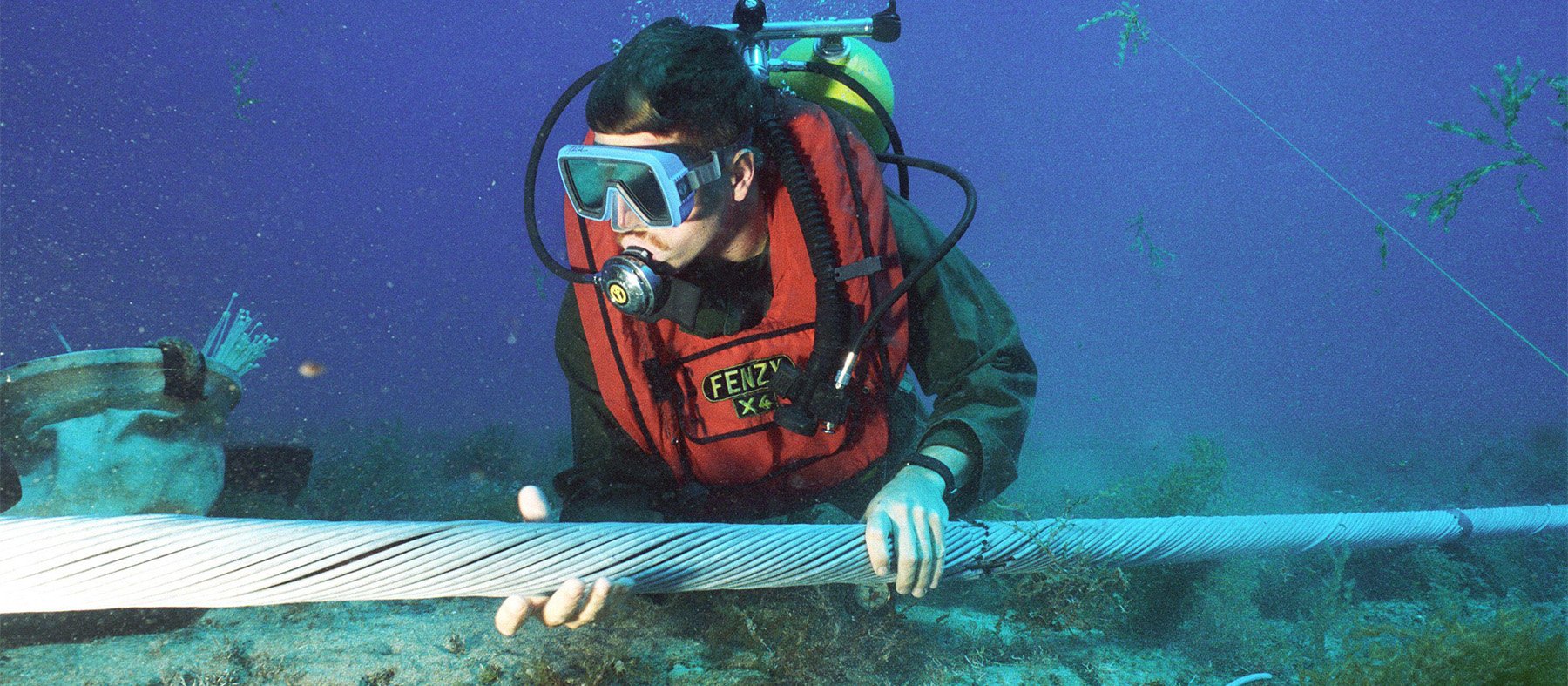
Undersea (submarine) cables are fiber-optic cables laid on the ocean floor that link countries and continents, carrying phone calls, internet data, and even financial transactions across the globe. They are often called the “invisible backbone” of the internet. In fact, more than 95–99% of long-distance global data traffic flows through these cables. Every email, video call or online purchase that crosses an ocean likely travels through one of these lines. The images below show real examples of submarine cables and the special ships that lay and repair them.
Why Undersea Cables Matter
Imagine the world’s data highways stretching under the seas. These cables are constructed of glass optical fibers that transmit vast amounts of information at the speed of light. Unlike satellites, which handle only a tiny fraction of internet traffic, submarine cables carry nearly all international data. Telecom analysts estimate they “transmit around 95% of global data flows”, underpinning roughly $10 trillion in daily financial trades. Over 500 cables span the ocean floors, operated mostly by private companies but critical to every country’s connection. For example, countries like the UK and Japan receive 99% of their overseas internet via cables.
Because so much depends on them, any threat to these cables is a strategic concern. A single cut cable can slow down or even cut off entire regions. Experts warn that critical sectors – banking, government communications, emergency services, energy coordination and more – would be hit hard by big cable failures. In isolated areas (such as island nations or remote coasts), losing a cable can mean days of outage until repairs come. Thus, nations and alliances treat cable security as a matter of national and economic security.
Undersea Cables Security – Key Vulnerabilities
Undersea cables are strong but vulnerable. They face both natural and man-made threats:
- Accidental damage (natural or accidental): Heavy fishing gear, ship anchors and underwater slides frequently break cables. Fishing trawlers dragging nets can snag a line, and ships’ anchors can accidentally drag across the seabed, snapping cables. Geologic events – strong currents, earthquakes or underwater landslides – can also cause breaks. For example, an undersea rockslide off West Africa once sheared through a cable, and storms or earthquakes can disturb the seabed. Analysts note that “subsea cable damage is commonplace” – on average, a cable is damaged somewhere in the world every few days. In northern waters, commercial fishing and anchor drags are the leading causes.
- Intentional sabotage: Cables have become targets for malicious attacks or espionage. Rival nations or militant groups may cut cables to disrupt an adversary’s communications or to spy on data. In recent years, there have been unexplained or suspicious incidents cables were cut in the Baltic Sea and off Taiwan under mysterious circumstances. In some cases, investigators suspect drag anchors from military or civilian ships deliberately cutting lines, possibly to hide the culprit. For example, analysts flagged a pattern of cable cuts attributed to “anchor dragging” by ships, some tied to a so-called Russian “shadow fleet”. A UK report highlighted a case where a ship’s anchor severed two cables in the Baltic, and intelligence suggests a Russian freighter mapped out sensitive cables. Because damage can look accidental, such acts can be hard to detect. A security firm noted that damaging cables can be an “attractive tactic” – it is cheap, can be blamed on an accident, and quietly cuts an opponent off.
- Cyber and supply-chain risks: The systems that run cables can be attacked electronically. Modern cable networks use remote management and buried sensors, which, if hacked, could disrupt service. For instance, data links that monitor cable health could be targeted by malware. Also, when cables break, special repair ships lift the cable ends and splice them. If a hostile nation controls a repair ship or equipment, it could tap into the cable or insert spy devices during a repair. U.S. officials have even warned that foreign cable-laying vessels might be used to gather intelligence or plant backdoors on cables while performing maintenance.
- Geopolitical tensions: In times of political conflict, undersea cables may be seen as soft targets. Government committees have warned that adversaries might try to “hit on our critical undersea infrastructure” during a crisis. High-level officials describe national cable networks as potentially “an increasingly vulnerable soft underbelly” of a country. As an example, Arctic tensions over Taiwan and the Baltic have raised fears that state-backed actors could cut cables to isolate countries or disrupt military communications. Indeed, some reports caution that when wars threaten, cables could be among the first targets to cripple an economy or spoil “digital will”.
Examples of Recent Incidents
In 2024–2025, several cable disruptions highlighted these threats:
- Baltic Sea (Europe): Dozens of fiber-optic cables linking Germany, Sweden, Estonia and other countries were mysteriously cut. Investigators say at least 11 cuts occurred since late 2023. Some blamed dragging anchors from ships, and others raised alarm over Russian spy vessels in the region. European leaders described the wave of cuts as “sabotage” by hostile state actors aiming to destabilize NATO allies. In response, NATO launched a “Baltic Sentry” mission using patrol planes, drones and warships to monitor and protect cables there.
- Taiwan and East Asia: In early 2023, two undersea cables near Taiwan’s Penghu Islands were cut, knocking out communications for local islands. A Chinese-crewed cargo ship zigzagged over the cable route and severed the lines, according to news reports. Taiwan’s authorities pointed to the activities of Chinese research vessels and ships laying claim to control of nearby waters. These incidents fit a broader pattern noted by analysts who observed state-backed ships in the region mapping cable routes.
- Red Sea and Middle East: In February 2024 a Houthi missile strike in the Red Sea caused a supply ship’s anchor to be lost. The drifting anchor then cut through submarine cables, leading to significant internet outages across parts of the Middle East. Although this was a byproduct of conflict, it illustrated how military actions can indirectly damage the cable network.
- North Atlantic (UK and nearby): The UK’s military reported Russian ships like Yantar circumnavigating Britain and surveying cable routes. While no cut occurred, UK officials took notice and warned of Russia’s advanced deep-sea capabilities that could attack cables covertly. In 2025, a UK parliamentary report likewise flagged concerns when a Russian vessel loitered near British cable landing sites, urging the government to beef up protections.
- Africa: An underwater landslide off the coast of Namibia (West Africa) in 2024 snapped cables, causing major internet slowdowns in southern Africa. Because there were few alternate routes and limited repair ships nearby, the outage was prolonged, illustrating that geography can worsen any disruption.
Consequences of Cable Disruptions
The effects of a major cable outage can be wide-ranging:
- Internet and Communication Blackouts: A cut cable can slow or block access to websites, cloud services, email and voice calls for many users. Time zone coordination for travel, shipping or finance may be disrupted.
- Financial and Economic Impact: As noted, about $10 trillion worth of financial data moves through submarine cables every day. A prolonged break could hinder electronic trading, banking transactions and payment systems. One analysis warned of “failures in payment systems and supply chains, degraded communications, [and] overstretched emergency responses” if multiple cables are severed.
- National Security and Emergency Services: Governments, militaries and emergency responders rely on secure, timely data. A surprise loss of connectivity can hamper military command, border controls, and disaster responses (like coordinating rescue after storms).
- Social and Psychological Impact: In today’s world, losing reliable internet is not just an inconvenience. People may be unable to contact family abroad, and distrust can rise if a massive blackout sparks rumors or panic. Even shorter disruptions can hurt businesses and erode confidence in critical infrastructure.
Enhancing Cable Resilience: International Cooperation and Innovation
Protecting the global cable network requires teamwork between governments, industry and international bodies. Key steps include:
- International Monitoring and Patrols: Alliances like NATO have launched missions to watch over cable routes. For example, NATO’s “Baltic Sentry” patrol in 2025 uses surveillance aircraft, drones and ships to monitor suspicious vessel activity near cables. NATO has also set up a dedicated undersea infrastructure security cell and new coordination centers to track threats. These efforts improve the chances of spotting a dangerous anchor or unknown ship before it does damage.
- Information Sharing and Agreements: Countries are increasingly sharing intelligence about undersea threats. In 2025 the European Union unveiled an action plan channeling over €1 billion (about US$1.1 billion) into better digital infrastructure, mapping cables, and common risk assessments. EU governments plan a “Cable Security Toolbox” of protective measures by 2025. Likewise, the U.S. Federal Communications Commission now applies strict rules: any new cable landing in the U.S. must avoid foreign adversary control or suspect equipment. These policies aim to reduce espionage risk and ensure cables use trusted components.
- Diversifying and Securing Routes: Cable owners are designing new cables with security in mind. This can mean choosing routes that avoid known hazards or adding spare paths. For example, a planned India-Europe cable (“Seacom 2.0”) is being built with multiple routes and landing points, so one cut won’t isolate the entire system. Burying cables deeper near shore, or marking “no-anchoring zones” around them, also helps. In some places, special concrete or armored sleeves protect shallow cable sections from trawlers.
- Improved Repair Capability: Quick restoration is crucial when damage happens. However, there is a global shortage of specialized cable-laying and repair ships. Both industry and government reports warn that too few ships and regulatory hurdles could delay fixes. Some countries are acting the UK committee recommended the government acquire its own repair ship and train navy crews in cable repair techniques. Japan likewise, is funding domestic cable vessels to ensure a rapid response. Investing in more cable ships and training is like having more ambulances ready to fix broken data highways.
- Technological Innovation: New tools are emerging to detect and deter threats. Underwater drones can patrol near cables, using sonar or cameras to spot anchors or unauthorized personnel. Smart sensors along cable lines can detect strange vibrations (from a ship dragging an anchor) and trigger alerts. Researchers are also exploring ways to make cables “self-monitoring”, sending diagnostic data continuously. On the cyber side, stronger encryption and authentication make it harder to hack cable control systems.
- Legal and Policy Measures: Deliberately damaging undersea cables is already illegal under international law (dating back to the 1880s) and many countries now have modern rules against. Authorities are calling for tougher enforcement: heavier fines, prosecution of vessels involved in cuts, and rapid law enforcement coordination across borders. As one UK official put it, we need “stronger physical protections, better options to impose genuine costs for malicious activity, and more comprehensive recovery plans”.
- Collaboration and Training: Perhaps most important is global coordination. No single country can guard the oceans alone. Experts stress that government agencies, submarine cable companies and international bodies (like the International Cable Protection Committee, NATO, and the UN) must work together. Drills and stress tests can prepare teams for crisis scenarios. Fishers and ship operators can be educated about cable locations so they avoid entanglements. In short, a network of cooperation – military, diplomatic and commercial – is forming to keep this shared infrastructure safe.
In summary, submarine cables may lie hidden under thousands of meters of water, but their importance is crystal clear. They are the linchpins of modern life, and their security is critical for everything from personal messages to global finance. By understanding the risks and working together internationally, we can help ensure that this vital infrastructure remains resilient – and that the digital information lifelines continue to flow uninterrupted across the oceans.
Article by Shaloo Singh