

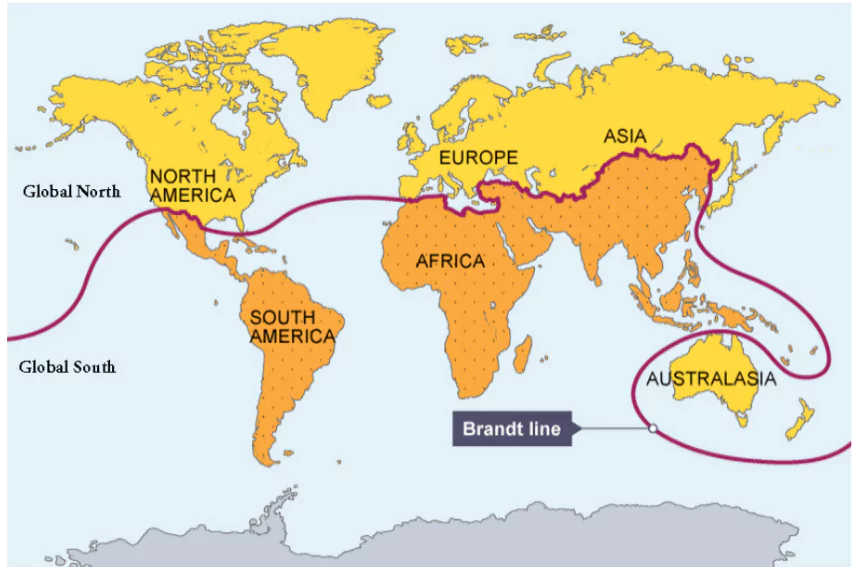
“Global South” is a general term for nations in Oceania and most of Asia, Africa, and Latin America and the Caribbean, which are generally less economically developed than the Global North. Most of them are also ex-colonies. Typical issues the nations encounter include reduced incomes, increased poverty, inferior infrastructure, and ongoing development needs.
The Global South then emerged as a value-free postcolonial successor to the obsolescent “Third World” nomenclature following decolonization, expressing solidarity among postcolonial nations calling for a more equitable international world. It represents a common call for greater voice and influence in global affairs.
The Perception of the Global North and the Global South
There has long existed a very common perception that the Global North; largely the United States and the Western Europe, occupies a quite superior position in world politics, while the Global South must adjust, tolerate, and simply comply. This belief was not entirely meant to be a mere source of imagination. For decades, the North has exercised enormous influence over global institutions, trade systems, finance, and security arrangements.
However, this dominance has created a strong hierarchical relationship, not a neutral one. The North has mostly depended on the South for resources, markets, strategic geography, political backing, and stability; but here comes the turning point: it did expect predictability and compliance in return. The South was never irrelevant; it was simply expected to remain manageable.
Why the Global South Accepted This Order?
The question naturally arises: why did the Global South accept this hierarchy for so long?The answer is quite simple; it simply had no real choice left. From the 1950s through the late 1990s and early 2000s, Global South economies were weaker, technologically way more behind, and militarily unequal. Resistance without capacity was purely impossible. The development mostly depended heavily on Northern institutions, markets, and financial systems. Neutrality during the Cold War was therefore defensive, not confident. Newly independent states avoided alignment not out of strength, but out of fear of being dominated once again. Even after the Cold War, many Southern states adjusted to a US-led global order because it appeared permanent and unchallengeable. Just as people cannot protest for those rights which they do not know exist, states cannot assert autonomy without understanding their leverage. Awareness had to come much before assertion; hence having a prior knowledge about something seems to be a mandate.
When the Shift Began
This mental shift did not begin immediately in 2020, it unfolded gradually. The first cracks started appearing between 2008 and 2012, when the global financial crisis exposed the fragility of Northern economic systems. The Southern economies suffered for decisions they had never made and this eventually eroded their trust.
Between 2014 and 2016, a strategic awakening followed. China’s sudden rise demonstrated that alternatives were always possible. The dependence on a single centre of power began to feel risky rather than safe; and thus the map of geopolitics started evolving through a series of transfers of power.
From 2017 to 2019, this realization accelerated. The trade disputes, coercive economic practices, and shifting rules made Southern states question why they should rely exclusively on systems that could be turned against them. They were slowly losing their sense of reliability. By 2023–2026, this shift translated into a similar behavioural change.
States acted differently because they now had several options, and because they knew they were needed.
Neutrality to Autonomy: ‘The Core Transformation’
Earlier, neutrality meant survival but today, autonomy means choice.
The Global South no longer merely balances powers; it rather selects partnerships based on mutual interests. This is where the strategy of hedging becomes central; keeping multiple options open to avoid the dependence on any single power.This is not random behaviour. It is a deliberate and focused one.
Across foreign policy, defence, trade, technology, energy, and international institutions, Global South countries now act strategically, extracting benefits rather than simply accepting the existing terms.
How the Global South Acts Today
In the major sphere of defence and security, countries often avoid exclusive military dependence. Excessive reliance on one external power risks the political influence and loss of autonomy. States like India diversify defence partnerships, while Turkey balances NATO membership with their independent choices. The benefits are strategic autonomy and reduced vulnerability; the risks include mistrust and diplomatic tension.
In technology and infrastructure, monopoly is strictly avoided. The mere ‘Dependence’ on a single supplier creates leverage for coercion. Diversification creates bargaining power and freedom of choice. In energy and resources, oil, gas, and critical minerals function as major political equipment. Organisations like OPEC, largely led by Global South states, influence global energy markets, while African states control minerals essential for modern industries and energy transitions.
In diplomacy and international institutions, Global South countries increasingly coordinate positions, demand governance reform, and leverage numerical strength. While the unity is imperfect and slow in decision making purposes, the strong collective influence has widely grown.
The Global South’s Resurgence and Agenda
Following decades of peripheralization, most countries of the Global South have enjoyed swift economic and population growth. Presently, the Global South is home to most of the world’s inhabitants and a rising proportion of global GDP and trade. The emerging powers like China, India, Brazil, and others have redrawn economic weight, showing power and ingenuity, defying traditional Western hegemony. Thus, for example, BRICS nations now control approximately 40% of global commerce and contain a large percentage of world manufacturing, and have created new institutions (like the BRICS New Development Bank) to meet Southern needs.
As a result, Global South voices are more assertive. Governments increasingly demand reforms to make world governance more inclusive. Common objectives include UN and Bretton Woods Reform, Equitable Development Financing, Fair Trade and Debt Relief, Climate Justice, and South–South Cooperation
South-South Cooperation and New Alliances
Global South nations are increasingly building their own platforms and alliances to push their agenda. The BRICS group (originally Brazil, Russia, India, China, South Africa) has expanded to include emerging economies from the Middle East, Africa and Asia, making it a “majority-world” bloc. BRICS serves as a key channel for developing countries to coordinate on economics and politics. For example, the BRICS Summit 2024 (Kazan, Russia) was explicitly themed “BRICS and the Global South: Building a Better World Together”, underlining the group’s outreach beyond its core members. As BRICS expands, it increasingly “represents the great majority of the world’s population who live in the developing world”.
Similarly, G20 membership has been broadened and agendas set to reflect Southern concerns – for instance, India’s 2023 presidency secured a permanent G20 seat for the African Union. Other initiatives like the Global South–South Development Fund, regional trade pacts (AfCFTA, ASEAN), and the UN’s Office for South–South Cooperation all aim to build capacity and solidarity among developing nations. These new alliances allow the Global South to reduce dependency on traditional Western-led bodies and “widen the choices” for global cooperation.
Together, these platforms shape a more multipolar world order. Leaders at the 2025 BRICS Summit in Brazil explicitly linked BRICS’ diversity and multipolarity to global governance change. India’s Prime Minister Modi has underscored that “diversity and multipolarity are valued strengths of the BRICS” and stressed that “BRICS could play an important role in shaping a multipolar world”. British analyst Martin Jacques similarly observed that BRICS’ expansion gives developing countries a louder voice and ultimately could make the Global South the “majoritarian element in global governance”.
Leadership and Initiatives from India and Others
India has become a voice leader of the Global South, defining its place in international platforms. Indian leaders and Prime Minister Narendra Modi routinely, in orations and diplomacy, attempt to define the necessity for an inclusive global order that privileges the South.
For example, India’s External Affairs Minister Jaishankar told a BRICS outreach meeting in October 2024 that the world is faced with a paradox: “Some of the developing countries are richer and the old order is changing, but there are lots of inequalities remaining.”. He argued that institutions like BRICS must be made stronger “to make a difference for the Global South,” and that institutions like the UN, IMF and World Bank must undergo immediate reform in order to be adjusted to realities of today.
He also provided concrete steps: diversifying production chains, regional connectivity in place, and innovations shared (i.e., India’s digital public infrastructure and solar alliance) so that globalization benefits are made more equally available.
At the global level, India used its recent G20 presidency to elevate Southern concerns. It brought African leaders into the G20 and launched initiatives on climate finance, health, and digital cooperation. He highlighted the urgent need for climate finance and technology transfer to developing countries and declared that sustainable development in the South requires “access to climate finance and technology”.
The Major Rivalries and the Global South’s Role
Today’s strongest rivalries involve the United States, China, and Russia, but their
roles differ. US–China rivalry is systemic; economic, technological, and strategic. Meanwhile the US–Russia rivalry centres on defence and security. And the China–Russia relations are cooperative but extremely cautious.
The Global South is no longer the prime source of serving the role of a battlefield in these rivalries. It is now acting as the deciding space. Major powers compete for its markets, resources, diplomatic support, and legitimacy. This is where leveraging rivalry comes in: using competition between the great powers to extract benefits without permanent alignment. Sanctions, Pressure, and the Limits of Control Sanctions remain one of the strongest tools of the Global North. Before 2010, they were totally devastating. Today, they still hurt but here’s a major change, they no longer guarantee compliance. Sanctions cause economic pain, political hardening, and long-term resentment. Populations suffer first; and political systems adapt eventually. Overuse erodes moral authority and encourages alternative networks; this serves as a crucial reminder that ‘sanctions cannot always create a political monopoly. The outcome is not war, collapse, or separation; but a fragmented, negotiated, and unstable global order.
Literary Parallel: Delayed Resistance and the Breaking Point
This pattern of endurance followed by resistance finds a powerful parallel in Beloved by Toni Morrison. In the novel, resistance does not emerge immediately; it arrives only after prolonged suffering reaches an unbearable threshold. Morrison’s narrative shows that domination often survives not because it is accepted, but because alternatives appear absent. The moment endurance turns into awareness, submission transforms into assertion. Similarly, the Global South did not challenge global hierarchies for decades not out of consent, but out of asymmetry of power. What appears today as sudden political pushback is, in reality, the outcome of incremental pressure finally crossing its limit.
Conclusion
The Global South is no longer neutral because neutrality no longer serves its fundamental interests. What has emerged instead is autonomy: active engagement, strategic hedging, and calculated bargaining.
Hence, it is now evident that the Global South is actively reshaping the important contours of global politics. Power is no longer concentrated solely within the grip of the Global North; instead, it is being redistributed through negotiation, leverage, and selective engagement. Diplomatic practice today reflects this shift clearly; where we can easily trace that ‘neutrality is no longer passive or silent but has evolved into selective autonomy, where choices are deliberate and interests are prioritised’. As dependencies become mutual and options keep multiplying, global politics enters a deeper, more complex phase in which the main authority is contested, influence is negotiated, and outcomes are shaped collectively rather than commanded unilaterally.
Echoing the logic of The Dark Knight, the Global South has recognised that excessive pressure does not reinforce power; it exposes its limits. Power today lies not in domination, but in the ability to choose.
Article by The Wonk Team