

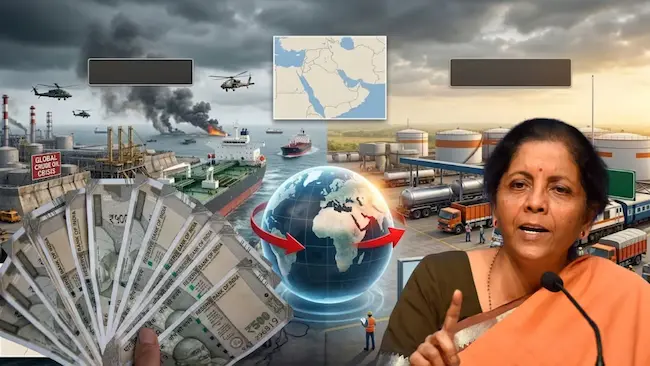
In order to easily comprehend the politics of oil crisis 2026, it is first necessary to examine the ongoing global situation. In the recent few months, tensions in the Middle East have once again made the global oil market extremely unstable. The escalating tensions involving Iran, Israel, and the United States have created ample amounts of uncertainties in the global energy supply routes.
One of the central elements of this instability is the Strait of Hormuz. Nearly one-fifth of the world’s traded oil passes through this narrow waterway. And because of this enormous dependence, even the potential of disruption can cause oil prices to rise and global markets to react nervously, which is quite obvious.
This situation highlights a broader concern: ‘energy security has become a crucial geopolitical issue in the contemporary world’
Why Oil Prices Rise During Conflicts?
Oil prices are volatility sensitive to geopolitical turbulence, a truth which not even a single nation could deny. When conflicts threaten supply routes, markets instantly start to fear that their oil shipments may be interrupted. Since oil remains as an essential source for transportation, industry, and energy production, any disruption immediately influences global prices.
The Strait of Hormuz plays a central role here. About 20 percent of the world’s oil trade moves through this narrow passage. If tensions escalate or shipping becomes very unsafe, then the oil supply to international markets may decline, thereby causing the prices to rise sharply.
OPEC and the Politics of Oil
Another key factor influencing global oil prices is the role of the Organization of the Petroleum Exporting Countries (OPEC).It was founded in the year 1960, OPEC was created so that oil-producing countries could coordinate their production and gain greater control over global oil markets. But before its formation, large Western oil companies exercised control over oil pricing and most of the crucial production decisions.
OPEC works primarily by controlling supply. When oil supply increases, prices usually fall. When supply decreases, prices rise. So by adjusting the production quotas, OPEC members can significantly influence the historical global oil markets.
The Major members of the OPEC include:
¤ Saudi Arabia
¤ Iran
¤ Iraq
¤ United Arab Emirates and
¤ Kuwait
In the recent few years, OPEC has also cooperated with several other oil-producing countries such as Russia through an expanded framework which is popularly known as ‘OPEC+’
Which Countries Suffer From Oil Crises?
The Countries that depend heavily on imported oil are the most susceptible when global prices rise. Let’s have a look at these countries to understand the dominant role of geopolitics which includes the politics of oil as well.
Major oil-importing economies include:
☆ India
☆ Japan
☆ Germany
For these countries, rising oil prices lead to several economic consequences, and they are :
i. petrol and diesel become high priced
ii. transportation costs increaseiii. The inflation surges
iv. economic growth slows
India is notably vulnerable because it imports the majority of its crude oil from other countries.
Which Countries Mostly Benefit From Rising Oil Prices?
Remarkably, the high oil prices can benefit some oil-exporting nations. And these Countries which produce large quantities of oil may earn significantly more revenue when global prices rise. One example is Russia. When the oil prices increase, Russia earns higher export revenues. After the Ukraine war and Western sanctions, Russia began selling oil at discounted prices to countries such as India and China, which increased their imports.
Where Does the World’s Oil Come From?
Most global oil production comes from a very limited number of regions and countries.
Some of the Major oil producers include:
▪ Saudi Arabia
▪ United States
▪ Russia
▪ Iran
▪ Iraq
▪ United Arab Emirates ( UAE)
An extensive share of the global oil reserves is accumulated in the Persian Gulf. Because of this concentration, most conflicts in the Middle East region can have severe global economic consequences, as we are currently facing now.
Why the Strait of Hormuz Is So Important?
The Strait of Hormuz connects the Persian Gulf to the open ocean. Oil exported from countries such as Saudi Arabia, Iraq, Kuwait, and the United Arab Emirates must pass through this narrow route ( Strait of Hormuz) to reach the corresponding global markets.In geopolitics, narrow passages like this are called chokepoints because large volumes of trade pass through a very small route. This makes them vulnerable to disruption. And Iran lies along the northern coast of the strait, while Oman lies on the opposite side.
Because of its geographic position, Iran has the ability to threaten shipping routes during the major conflicts.
The 1973 Oil Crisis and Its Lessons
The modern politics of oil was mostly shaped substantially by the 1973 Oil Crisis. During the Yom Kippur War, several Arab oil-producing countries restricted oil exports to those nations that supported Israel. As a result of this restriction, oil prices rose dramatically and many economies faced severe shortages and inflation.
The crisis demonstrated that energy resources could be used as severe geopolitical weapons.
How Countries Prepared After the Oil Crisis
After the 1973 crisis, many countries adopted several policies to protect themselves from the future disruptions. These included:
1. building strategic oil reserves
2. diversifying oil suppliers
3. improving their fuel efficiency
4. investing in various alternative energy sources
For example, the United States created the Strategic Petroleum Reserve to store emergency oil supplies.
Why the World Still Depends on the Middle East for Oil Consumption?
Despite efforts to diversify the energy sources, the Middle East remains central to global oil supply. The region possesses some of the largest and cheapest oil reserves in the world. Thus making it a region which the world could hardly ignore.
Even though countries are investing in renewable energy, nuclear power, and electric vehicles, the global economy still depends heavily on oil from the Persian Gulf.
Russia as an Alternative Oil SupplierUnlike the Gulf producers, Russia’s oil exports are not dependent on the Strait of Hormuz. Russian oil is transported through pipelines to Europe and through ports in the
Baltic Sea, Black Sea, Arctic, and Pacific regions. This is one reason why countries like India increased imports of Russian oil after the Ukraine war.
Countries Most Vulnerable to Strait Disruptions
Asian economies are especially vulnerable if the Strait of Hormuz is disrupted.
The Major importers include:
China
India
Japan
South Korea
European economies such as Germany and Italy would also be affected equally.
Why the United States and Iran Are often in a Conflicting Situation?
One of the major reasons for tensions between the United States and Iran is Iran’s nuclear program. Several countries signed the Joint Comprehensive Plan of Action to restrict Iran’s nuclear activities in exchange for lifting sanctions.
However, the United States suddenly withdrew from this agreement in the year 2018, which kept increasing the existing tensions again.
For policymakers in Washington, preventing nuclear proliferation in the region is often seen as a priority even if it creates severe economic risks.
Oil Crisis 2026 – Possible Future Scenarios
Analysts generally describe three possible outcomes:
● Best scenario: diplomatic de-escalation and stable oil markets.
● Middle scenario: ongoing tensions but manageable price volatility.
● Worst scenario: a major regional conflict disrupting shipping routes and causing a global economic crisis.
Conclusion: The Structural Vulnerability of the Energy System
The global economy remains deeply dependent mostly on the oil transported through a few narrow maritime corridors. As long as a large share of global energy supply passes through chokepoints like the Strait of Hormuz, the geopolitical tensions in the region will continue to sway these global markets.
The politics of oil therefore reveals a deeper structural fragility. Energy resources are not only economic commodities; they are strategic assets that shape diplomacy, alliances, and international power relations.
In a world where geopolitical tensions can escalate quickly, energy security has become one of the most critical challenges of our time.
In many ways, the contemporary debate on energy security echoes a famous dilemma from Shakespeare’s Hamlet: “to be or not to be.” In the twenty-first century, energy security is no longer merely an economic concern; it has become a question of survival for modern states. The stability of transportation, industry, and even everyday life depends much on the uninterrupted access to energy resources. In this sense, global energy networks function almost like a watchful system, quite reminiscent of
Michel Foucault’s idea of the panopticon, where constant awareness and vigilance shape behaviour. Governments today must keep a careful eye on existing supply routes, geopolitical tensions, and strategic reserves. While complete strategic withdrawal from the Gulf energy sources is neither realistic nor practical, the lesson of recent crises is crystal clear: nations must gradually build alternatives, diversify suppliers, and strengthen their energy security so that the global economy does not remain vulnerable to disruptions in a single fragile region.