

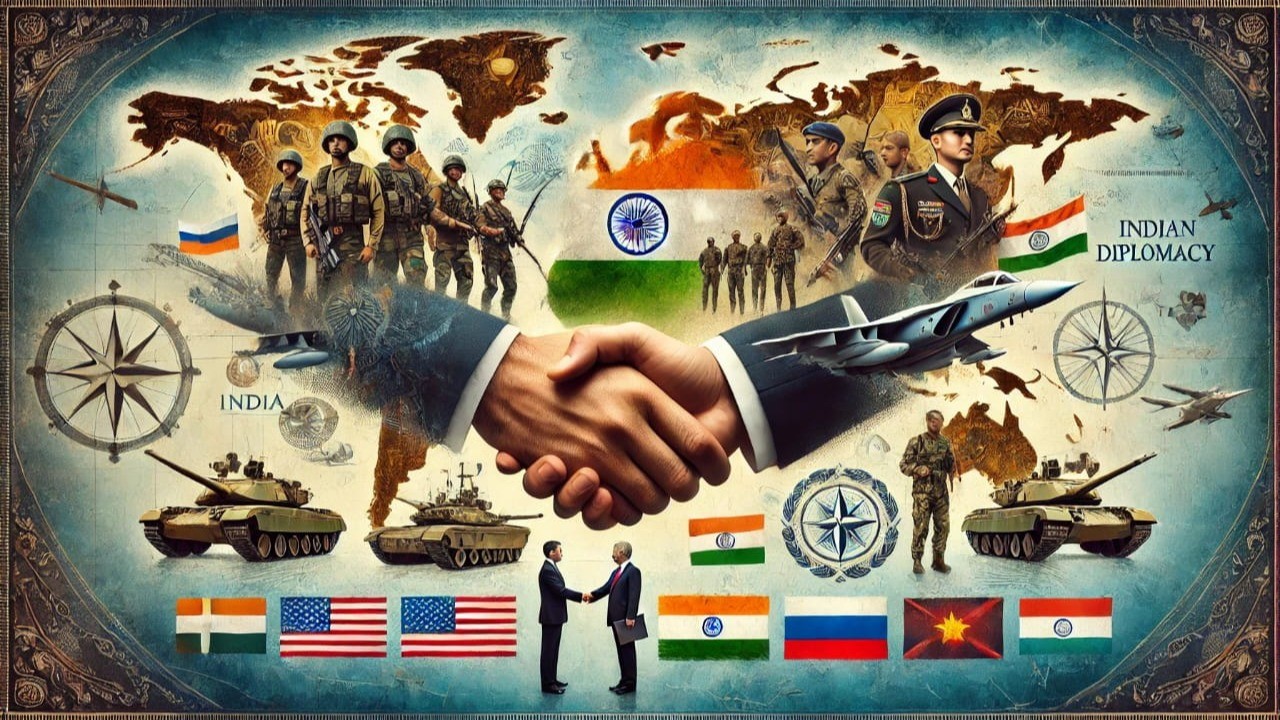
Before delving deep into India’s evolving role in the Indo-Pacific, it is quite necessary to understand what alliances really signify in geopolitics. Alliances are not merely supplementary mechanisms or symbolic partnerships; rather, they are well structured systems of mutual support through which countries agree to assist one another during their essential times of crisis.
In a geopolitical world where complete independence is nearly impossible. Nations are often required to depend upon the foreign trade, defence technologies, intelligence cooperation, or economic partnerships in order to function effectively. The Alliances therefore becomea prime source of coordinated frameworks where countries collectively secure their position in the international hierarchy.
To comprehend this term more simply, one may consider the example of a classroom where students form several groups. If one group gathers support from multiple others, it may possess the capacity to overpower another group that lacks the similar backing.
Once a country becomes a part of such a grouping, it gains tremendous collective support but may also inherit expectations that limit its freedom to act independently hereafter.
Traditional Alliance Politics and India’s Divergence
Historically speaking, countries have often tried to strengthen their global influence through alliance-based arrangements such as NATO or through strategic partnerships developed by major powers. These alliances provide treaty-based protection and security guarantees, ensuring that support will be extended during conflicting hours or crises. However, they may also reduce their policy flexibility by creating expectations of cooperation even in those particular situations where national interests may diverge to a large extent.
India’s contemporary diplomatic practice reflects a crystal clear departure from this traditional model. Rather than committing itself to bloc-based alignments, India oftentries to engage in various military cooperation through joint naval exercises, port visits, technology sharing, intelligence exchanges, training programmes, and structured defence dialogues. These interactions clearly improvise the existing operational coordination without obligating India to participate in conflicts on behalf of the other partner nations. In this essence, India appears willing to cooperate, train, and engage with multiple countries, yet it completely avoids formal military alliances that may constrain its strategic autonomy. Thereby potentially constraining India’s independent decision making in external conflict situations.
The Indo-Pacific as a ‘Strategic Theatre’
The Indo-Pacific region, extending from the vast Indian Ocean to the western Pacific Ocean, includes key actors such as India, Australia, Japan, ASEAN countries, and the United States, alongside the expanding strategic presence of China. This region has emerged as one of the strongest geopolitically significant zones in the world due to its concentration of maritime trade routes, energy supply corridors, and military installations. In such a huge strategically sensitive environment, there are countries which traditionally seek to consolidate security guarantees by aligning themselves with the most powerful blocs, which thereby serves as a source of power and authority for them in return.
India, however, while participating in initiatives such as the QUAD, conducting exercises like MALABAR, and hosting international fleet reviews, continues to maintain that it is not formally aligned with any kind of military bloc. This reflects its commitment to strategic autonomy. Here comes a poised question; what is strategic autonomy? It’s a principle that allows cooperation without dependency. India retains the sole freedom to determine when to cooperate and when to disagree, even while maintaining strong partnerships with various other nations.
Strategic Autonomy: Cooperation Without Obligation
Strategic autonomy enables India to cooperate, partner, train, and engage internationally while avoiding permanent alliance commitments with other nations . In practical terms, this ensures that India is not obligated to participate in conflicts that may not directly concern its national interests. While formal alliances provide guaranteed support during crises, they may also introduce constraints that reduce independent policy making. In contrast to this, cooperation without alliances offers greater diplomatic flexibility but introduces uncertainty, as assistance during emergencies may depend upon the goodwill of the nation leader rather than a formal obligation being implied on.This may be illustrated through a simple analogy. A student who does not join any particular group in a classroom, completely retains the freedom to interact with everyone. However, in times of extreme difficulty, support may or may not be guaranteed. The concept of assistance becomes contingent upon relationships rather than formal commitments. Similarly, India’s decision to avoid alliances may grant it flexibility, but it also introduces the possibility that support during crises may remain uncertain. And this certainly serves as a major drawback of India’s strategic autonomy.
India’s Expanding Network of Partnerships
India’s cooperation network demonstrates this approach in practice. With the United States, it conducts joint naval exercises such as MALABAR, engages in maritime security cooperation, and participates in defence technology and logistics sharing without entering into a formal military alliance treaty. India similarly collaborates with Japan on maritime domain awareness and Indo-Pacific infrastructure development, with Australia on defence dialogue and joint exercises, and with France on naval logistics and Indian Ocean cooperation. Engagement with ASEAN countries such as Vietnam, Indonesia, and Singapore further strengthens maritime safety and defence dialogue.
In each of these cases, the existing partnership exists without alliance commitments. India strengthens defence partnerships, conducts joint exercises, and enhances operational coordination without promising to participate in conflicts on behalf of its partners.
Operational Illustrations of Defence Diplomacy
India’s activities in the Indo-Pacific further illustrates how defence diplomacy may function without alliances. During anti-piracy operations in the Gulf of Aden from 2008 onwards, the Indian Navy deployed warships to escort commercial vessels and respond to piracy threats, cooperating with US, European, and Japanese maritime forces without joining any alliance framework. In humanitarian crises such as the Indian Ocean tsunami of 2004, India provided naval assistance and rescue operations in coordination with international partners.
A similar example may be observed in Operation Rahat in 2015, when India evacuated not only its own citizens but also nationals from more than forty countries during the Yemeni civil war, coordinating with Saudi and US authorities without treaty-based obligations. More recent exercises further highlight this model. The India–US tri-serviceExercise Tiger Triumph 2025 involved approximately 3,000 personnel from the army, navy, and air force in humanitarian assistance and crisis-response simulations in
Visakhapatnam and Kakinada. Likewise, Exercise Varuna 2025 with France enhanced maritime interoperability through joint naval coordination. India’s maritime cooperation has extended to agreements such as the 2025 India–Australia Maritime Security Framework and initiatives like the Africa–India Key Maritime Engagement (AIKEYME) 2025. Naval deployments, including those of INS Tushil across multiple continents, have facilitated bilateral exercises and anti-piracy patrols without alliance commitments.
Advantages, Limitations, and the Road Ahead
India’s deficiency of alliance obligations allows it to pursue independent defence and trade policies, even amid disagreements such as tariff pressures linked to defence purchases from Russia. Not aligning with a bloc is no longer viewed solely as isolation but as a form of strategic positioning in an increasingly issue-based diplomatic environment. While this model provides decision making freedom and diplomatic flexibility, it also carries the risk of limited secured support during intense crisis moments.
India’s strategy reflects a broader shift in the bigger global diplomatic circle from rigid bloc politics to issue-based cooperation. Whether sustained cooperation can generate informal support networks strong enough to function in the absence of formal alliances remains totally uncertain. The effectiveness of India’s approach will ultimately depend on whether cooperation can substitute alliance-based security frameworks in the evolving geopolitical order of hierarchy.
Even then, the question still persists whether India will ultimately benefit from the strategic autonomy it is currently pursuing. This is something that only time and evolving geopolitical circumstances can ultimately evaluate in the broader spectrum of international relations. The future of cooperation networks often remains inherently unpredictable, as diplomatic partnerships are often subject to tremendous fluctuations, which can hardly be predicted on time. For instance, there have been phases where
India–US relations appeared strained due to tariff pressures and divergence over defence purchases, followed by periods of renewed interaction and coordination . Such primary oscillations are not uncommon in the big periphery of global politics, and they indicate that partnerships may shift based on changing strategic priorities.
If this approach is examined through a different lens, one may draw a parallel with Rudyard Kipling’s The Jungle Book and the character of Mowgli. Mowgli, althoughraised within the animal kingdom, recognizes that he does not fully belong to this natural habitat. At the same time, upon encountering the human world, he suddenly realizes that complete assimilation into human society may also be difficult, since he’s not used to the homo sapiens sapiens culture and existing norms. Having been supported by multiple groups during his upbringing, he does not restrict his loyalty to any single community. Instead, he navigates between these worlds, by maintaining relationships with all the groups thereby preserving his independence of choice.
This condition places him in an intermediate space where neither the jungle nor the human settlement can entirely dictate his actions. In a similar manner, India’s strategic approach in the Indo-Pacific reflects an attempt to engage with multiple partners without formally aligning itself with any single bloc. Just as Mowgli retains the autonomy to determine his course of action without external coercion, India seeks to maintain the freedom to cooperate where necessary while avoiding obligations that may constrain its independent decision-making.
Conclusion
India’s present strategic trajectory may also be interpreted through the lens of Robert Frost’s “The Road Not Taken”. In Frost’s poem, the act of choosing a path less travelled does not guarantee immediate clarity regarding its outcome; rather, it reflects a willingness to navigate uncertainty in pursuit of independent judgment. In international politics, alliance-based security often represents the conventional route, one that promises predictability through collective guarantees. India’s emphasis on strategic autonomy, however, suggests an inclination towards an alternative approach: engaging in cooperation without permanent alignment. Such a policy necessitates huge risks, as the absence of treaty based obligations may limit assured support during crises.
Yet, it concurrently allows the possibility of leadership by demonstrating that influence in the contemporary geopolitical order need not be derived solely from bloc politics. In this sense, India’s defence diplomacy in the Indo-Pacific may be viewed as an attempt to operationalize a path that seldom emphasizes independent decision-making while upholding various functional partnerships across multiple actors.