

Twenty years after BRICS emerged as a grouping of major emerging economies, its New Delhi summit has posed a larger question: can a forum created to capture the increasingly influential world evolve into a meaningful force in altering the international order?
The answer is quite multifaceted.
The 18th BRICS Summit, held in New Delhi on September 12–13, brought together an expanded grouping of 11 members representing around 40 percent of global GDP and nearly half of the world’s population. Its 140-paragraph New Delhi Declaration called for greater representation of developing countries in global institutions, stronger economic cooperation, greater use of national currencies, more efficient cross-border payments, and cooperation across artificial intelligence, energy, critical minerals, food security and supply chains. But the significance of the summit is not simply that BRICS has become larger. The more strategic question is whether it is becoming more strategically positioned.
BRICS is not merely building a successor for the Western-led order. It is building more room for countries to operate outside it.
Beyond the “anti-Western bloc” narrative
BRICS is regularly depicted as a counterweight to the United States and Europe. There is certainly some truth in that description, but it is too one-dimensional.
Officially, the BRICS does not simply define itself as an anti-Western alliance. India, in particular, has consistently stressed that the grouping is not targeted against any country. Yet its political language steadily challenges a system in which Western institutions, currencies and strategic preferences have historically enjoyed dominant influence.
At the New Delhi summit, Prime Minister Narendra Modi argued that the Global South should move from being “rule-takers” to “rule-shapers.” The articulation captures India’s preferred vision of BRICS: not the replacement of one dominant bloc with another, but a more representative international system.
Russian President Vladimir Putin offered a more nuanced and confrontational interpretation, strongly arguing for a more balanced and multipolar world order and criticizing attempts to contain emerging powers. China went further in presenting BRICS as a platform for deeper cooperation in AI, industrial development, digital infrastructure and global governance. Xi Jinping called on BRICS to become a pioneer in innovation-driven development and said the grouping should contribute to shaping international order towards greater justice and equity.
These positions are not fully aligned. And that is precisely what makes BRICS particularly relevant.
Four levels of the BRICS challenge
The challenge BRICS presents to the existing order operates on at least four levels :
The first is symbolic. BRICS gives emerging and developing countries a collective platform from which to demand more substantial representation. The New Delhi Declaration supports reform of institutions including the United Nations and the international financial architecture, thereby reflecting the argument that the distribution of global power has changed faster than the institutions created after the Second World War.
The second is institutional. BRICS is no longer simply a summit where leaders issue political statements. It has the New Development Bank, the Contingent Reserve Arrangement, sectoral working groups and a growing network of cooperation mechanisms. The latest declaration explicitly describes the NDB as a crucial BRICS institution and encourages it to expand local-currency financing, mobilize resources and support infrastructure and economic integration.
The third is strategic. BRICS is increasingly discussing the infrastructure of economic power itself: payment systems, local currencies, critical minerals, energy, supply chains, technology and AI.
The fourth is geopolitical. If countries become less dependent on any single financial, technological or institutional centre, the ability of that centre to wield influence also becomes less exclusive.
The process is therefore cumulative:
local-currency trade → alternative payment channels → development finance → supply-chain diversification → critical-mineral cooperation → technology and AI cooperation → greater Global South coordination → greater diplomatic bargaining power.
None of these developments alone can significantly overturn the Western-led system. Together, however, they could gradually make that system less hegemonic.
De-dollarisation without a BRICS currency
There is still no BRICS currency, no common BRICS central bank and no cohesive monetary system. India has made clear that generating a common currency is not the immediate objective. Instead, the New Delhi Declaration focuses on something more practical: bolstering cross-border payment mechanisms, studying interoperability between payment and messaging channels, and promoting trade and investment settlements in national currencies while respecting the different strategic goals of the respective member states.
BRICS does not inherently need to replace the dollar to reduce reliance on it. If more transactions can be conducted through national currencies and alternative payment infrastructure, the dollar becomes one option among several rather than the inevitable intermediary. But even this project faces significant obstacles. BRICS members have different currencies, capital controls, exchange-rate regimes and trade balances. Payment connectivity does not automatically solve the problem of settlement. A mechanism can make it easier to transfer money without eliminating the fundamental economic imbalances that make some currencies less compelling than others.
So the pragmatic goal is not a sudden “de-dollarisation” revolution. It is an incremental expansion of payment choices.
The real weakness: BRICS does not agree with itself
This is where the strongest criticism of BRICS begins.
A 140-paragraph declaration does not necessarily translate into immediate institutional power. BRICS possesses enormous economic weight, but its political and diplomatic cohesion remains much nascent. Its members do not even share the same geopolitical interests. India and China still remain strategic competitors despite renewed diplomatic engagement. Iran and the UAE have sharply different regional interests. Russia’s relationship with the West is structurally adversarial, while India concurrently works with BRICS, the United States, Europe, the Quad and Russia.
The New Delhi summit provided a clear embodiment of this contradiction. BRICS was able to produce consensus on a wide range of issues, but much of the language was deliberately broad. The declaration denounced unilateral sanctions and tariffs without simply naming the countries responsible. This ambiguity is not necessarily a failure. It may be the price of keeping such a diverse grouping together. BRICS members have different relationships with the West, ranging from conciliation to autonomy, parity and confrontation.
So the criticism is completely defensible : how can countries with such different strategic interests become a consistent and coordinated alternative to the Western order?
The answer is not to dismiss the critics; their concerns are partly valid.
BRICS cannot currently function like NATO or the European Union. It has no common military structure, no common currency, no unified foreign policy and no comparable level of binding institutional commitment. But that may also be a misapprehension of what BRICS is trying to become.
Its members do not need to agree on everything. They can agree on narrower propositions: emerging economies should have greater influence in global governance; developing countries should have more economic policy space; financial dependence should be reduced; and cooperation can be deepened selectively in payments, trade, technology, AI, energy and critical minerals.
Has BRICS actually achieved anything?
A second criticism is that BRICS “talks a lot but delivers little.” Again, this criticism deserves to be given serious consideration but not exaggerated.
It would be factually wrong to say BRICS has achieved nothing. The New Development Bank exists, the Contingent Reserve Arrangement exists. There are sectoral mechanisms, working groups and financial and economic cooperation frameworks.
India’s 2026 chairship also produced a large number of initiatives across agriculture, digital agriculture, health, energy, technology and maritime cooperation. The declaration itself calls for stronger continuity and long-term institutional development.
The more constructive criticism is therefore not that BRICS has achieved nothing. It is that its institutional ambitions still exceed its demonstrated capacity to produce binding collective action.
Will payment initiatives become functioning mechanisms? Will local-currency financing expand? Will the NDB acquire greater financial weight? Will cooperation on critical minerals and supply chains produce concrete projects? Will AI initiatives create technological capacity rather than another series of forums? The answers will reveal whether BRICS is becoming an institution or simply becoming a larger conversation.
India is the contradiction at the centre of BRICS
India perhaps most clearly demonstrates why BRICS cannot simply be described as an anti-Western project. New Delhi is at the same time a part of the BRICS, the Quad and the G20, while deepening relations with the United States and Europe and maintaining strategic, defence and energy ties with Russia. India does not want one bloc to replace another.
It clearly wants strategic space.
That is why India’s approach to BRICS is different from that of Moscow’s or Beijing’s. Russia sees BRICS as part of the construction of a multipolar order that can counterweight Western dominance more directly. China increasingly sees it as a platform through which developing countries can cooperate on technology, industry and global governance. India wants BRICS to strengthen the bargaining power of the Global South without turning it into another rigid geopolitical bloc. The summit’s diplomacy reflected this role.
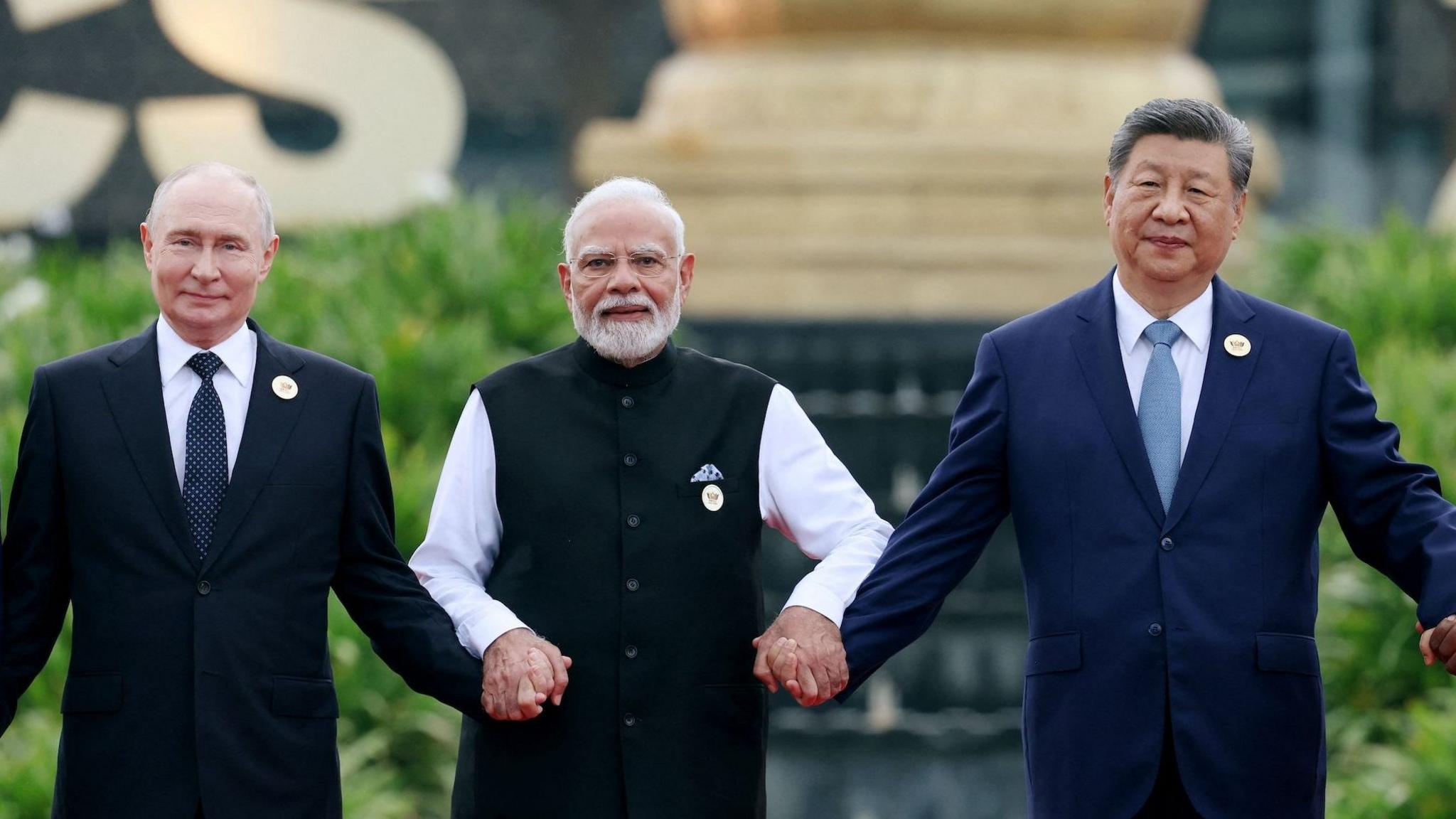
India hosted Xi Jinping and Vladimir Putin while also facilitating difficult conversations among countries with conflicting interests. Iranian President Masoud Pezeshkian and UAE Crown Prince Sheikh Khaled bin Mohamed bin Zayed held a consequential meeting on the sidelines, offering an illustration of BRICS functioning as a diplomatic platform even when its members do not share the same regional interests. This is an often overlooked form of power. BRICS does not have to speak with one voice on every geopolitical question to create diplomatic space for countries that otherwise have limited opportunities to communicate with.
China and the next phase
The transition to China’s chairship in 2027 could make the next phase especially significant. India’s 2026 chairship drew attention to practical cooperation, implementation and the interests of the Global South. China has already pointed to the possibility of a more ambitious agenda, including AI cooperation, open-source development, AI-enabled industrialization, digital ecosystems and deeper concerted action across industrial and supply chains. That could push BRICS further into areas that are increasingly central to geopolitical power. The future contest will not be influenced only by military strength or GDP. It will also involve computing, AI, semiconductors, energy, critical minerals, payment infrastructure and digital platforms.
Has Trump unintentionally strengthened BRICS?
There is one final paradox. Donald Trump’s tariffs, sanctions and unilateral economic policies may have unintentionally provided BRICS members with something they often lack: a common grievance. The New Delhi Declaration strongly expressed reservations about protectionism, unilateral economic measures and trade barriers while calling for a more representative global system. But one distinction is crucial:
Trump can give BRICS a common grievance without giving it a common purpose.
Opposition to particular American policies does not mechanically create a shared geopolitical strategy. India does not have the same interests as China. China does not have the same interests as the UAE. The UAE does not have the same interests as Iran. Russia’s confrontation with the West is not India’s relationship with the West. Therefore, Trump’s policies may strengthen the incentives for cooperation without eradicating the divisions that prevent BRICS from becoming a conventional anti-Western alliance.
So, is BRICS a threat to the US and Europe?
Not in the traditional sense of the term. BRICS is not about to replace the dollar, NATO, the European Union, the IMF, the World Bank or the broader Western financial system. It lacks the political cohesion and institutional depth required to assemble an alternative order overnight. But brushing aside it as merely a talking shop would be equally mistaken. The more important transformation is gradually unfolding. BRICS is attempting to create more options in payments, trade, development finance, technology, energy, critical minerals and supply chains. It is demanding greater representation for developing countries in global institutions. It is creating institutions of its own while trying to influence existing ones.
For Europe, the challenge is not simply military or financial. It is also about trade, energy, technology, supply chains and the future architecture of global economic governance. For the United States, the concern is more direct: a world with multiple payment channels, multiple sources of development finance and more diversified economic partnerships potentially reduces the leverage that comes from occupying the central position in the existing system.
But this is not the collapse of Western power. Rather, it is the gradual erosion of its exclusivity.
BRICS does not need to agree on the entire shape of the world to change how power is distributed within it. Its greatest challenge to the US and Europe may therefore not be confrontation, but competition through alternatives: a world in which emerging powers have more institutions, more payment options, more partnerships and more influence over the rules. BRICS is not building an alternative framework for the Western-led order. It is building more room to operate outside it.