

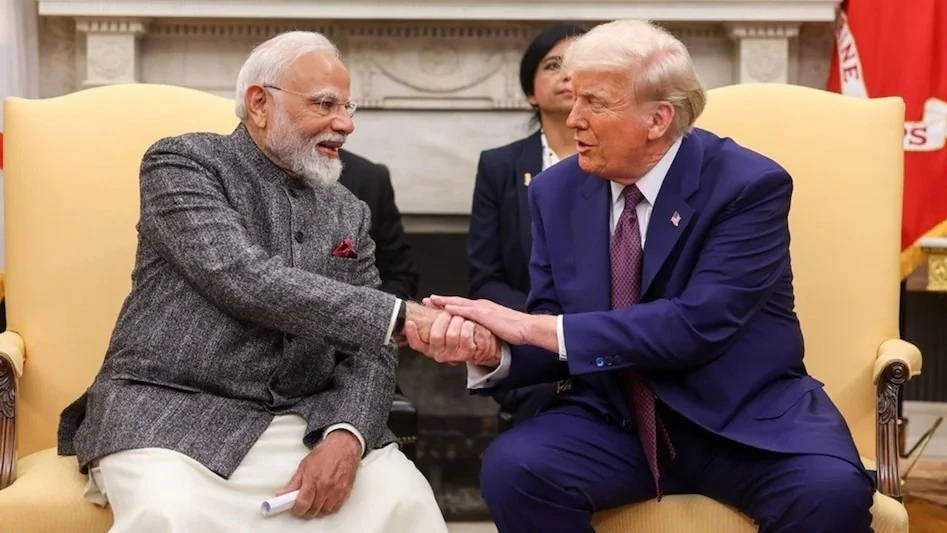
When Donald Trump remarked that he and Prime Minister Narendra Modi were “the only two who get things done,” the statement immediately grasped attention across several newsrooms and social media platforms. At the very first glance, it appeared to be another instance of Trump’s familiar praise-heavy rhetoric. But through the lens of geopolitics, statements are rarely casual.
To understand what Trump meant and why it matters now, one must carefully navigate beyond the headline and scrutinise the broader political and historical context in which it was made.
Reading statements in geopolitics
In international politics, no comment has ever been accidental. This is why every public remark demands scrutiny, and not just mere reaction.
Trump’s statement was not an endorsement of India as a civilisation or a blanket approval of its policies. What Trump was referring to was far narrower and far more specific: a leader-to-leader equation in the contemporary political moment.
In very simple words, Trump was signalling that Modi is someone he considers workable; someone with whom decisions are made quickly and outcomes are easily visible. The praise was directed at personal effectiveness, not national ideology or governance philosophy.
The immediate backdrop of the comment
The remark emerged during a media interaction in which Trump was reflecting on several global leaders and their governance. In reference to that context, Modi was mentioned, and Trump recalled their past working equation. The statement was retrospective, not a declaration of policy. It did not announce a new diplomatic initiative or strategic shift.
So, here lies the central question: why did it suddenly dominate headlines?
The answer lies LESS in what Trump said and more in how the media has amplified it. The media did not decode the statement; it amplified a familiar political narrative, as usual. It was clearly Amplification and not discovery, which made it newsworthy.
Decoding vs Amplification: How the Media Works
In this case, the media did not decode Donald Trump’s remark first; it amplified it strongly. The sentence was short, quotable, and directly involved two globally prominent leaders. It aligned neatly with an already familiar India–US narrative. That made it quite headline-friendly. The attention, therefore, was not accidental, but it was curated. Power, Reassurance, and the Animal Farm Analogy.
This is where literature becomes especially useful; the exact junction where we begin to analyse real stances to those examples which have been quoted by writers and philosophers much before the genre of Geopolitics came into its proper existence. George Orwell’s Animal Farm offers a sharp metaphor for understanding this political reassurance. In the novel, when power shifts hands, behaviour changes but the concurrent instincts remain the same. The authority rarely announces itself as domination; it often arrives as a mere source of reassurance; a language that sounds comforting, stabilising, even morally correct.
The animals are not ruled through constant force but through the different narratives that appear reasonable and quite necessary. Lies are not presented as lies; they are simply deciphered as protection. This does not mean every political reassurance is deception, but it does mean reassurance must be read carefully. Power often prefers consent over coercion.
Dictatorship, in reality, does not exist only in absolute terms. It exists to a certain degree. Some exercise full control, while others try to create a partial influence, but the impulse to consolidate the authority remains a constant.
Why This Matters for Trump’s Statement
Trump’s language often operates within this spectrum of reassurance. His remark does not reveal his intent directly; but it clearly stabilises the perception. It reassures the allies and reminds the audiences of the existing past cooperation, and reinforces his own image as a negotiator who can operate despite tremendous friction. This is not about moral judgment, it is about recognising how political language functions. Understanding this helps avoid both blind acceptance and unnecessary suspicion. It allows the statement to be read as what it is:a rhetorical tool shaped by power, memory, and political necessity.
The tariff episode and what it has revealed
One of the most visible disruptions came through the route of trade. The US imposed tariffs on Indian goods, raising costs and reducing competitiveness in theAmerican market. These tariffs were not personal attacks; they were symbolic instruments of pressure. They demonstrated that even partnerships operate only on transactional and conditional terms.
Crucially, Trump’s remark comes after this visible trade friction, not in its absence. That context changes its meaning entirely. “Getting things done” does not directly imply a smooth or friendly relationship. It rather emphasizes a relationship that survives several disagreements without collapsing into hostility or disengagement.
Tariffs weakened the relationship rhetorically by showing that trust has limits and economic interests override the common notion of mere sentiment. But they also strengthened it by proving that engagement continued regardless. The dialogue did not collapse. The Communication channels remained open. The relationship was neither ideal nor broken; it was kind of functional under extreme pressure.
What keeps the Relationship Intact
Despite disagreements, dialogue between India and the US has never collapsed. What emerged instead was a form of working pragmatism. Neither side has ever expected full ideological alignment. The Cooperation has mostly focused on practical domains; like the defence coordination, strategic dialogue, and the issue-based collaboration, while the clear disagreements were managed rather than escalated. This is the pattern Trump was referring to.
Transactions that matter
India–US relations are sustained less by symbolism and more by transactions. From the American side, India is valued primarily as a services and capability partner, not as a raw-material supplier. Indian IT and digital services underpin American corporate infrastructure, creating long-term interdependence.
Pharmaceuticals form another critical pillar, with India supplying large volumes of generic medicines to the US market. India, in turn, relies heavily on the US for defence equipment, advanced aircraft, helicopters, surveillance systems, energy supplies, capital goods, and high-end technology. These are not easily replaceable dependencies on either side. This mutual reliance intends to explain why trade disputes, including tariffs, fail to derail the broader relationship.
Why India stands out
The US has trade and strategic disputes with many other countries, including its close allies as well. The real question is not why India faces constant pressure, but why it is often singled out positively despite it.
India occupies a rare middle position in the periphery of global politics. It is not a formal US ally, not dependent on American security guarantees, and not hostile to US interests. It negotiates hard, disagrees openly, but does not disengage. That balance actually matters a lot, it certainly works in the favour of India.
Trump’s rhetoric tends to be harsh toward countries he sees as exploitative, rigid, or uncooperative. India fits none of those explicit as well as implicit categories. Its diplomacy is visible, assertive, and independent; qualities that leave an ever lasting impact in Trump’s political memory.
Why does this statement matter now?
Global politics today is quite fragmented, unlike before. Alliances are no longer rigid, and countries increasingly opt for issue-based cooperation. In such an intense climatic atmosphere, India’s model; independent yet cooperative, this stands out!!
Trump’s comment, stripped of sentiment, reflects this reality in a better form. It easily recognises a relationship that has moved from distance to engagement, from disagreement to managed cooperation, and continues to cycle through these phases without collapse. In geopolitics, reassurance is often the most powerful stabilising force. Trump’s remark functions precisely as that: a reminder that despite friction, the relationship endures. Not because it is smooth, but because it works.