

China is a country where conviction rate exceeds 99 percent and acquittal rate plummets down to less than one percent; expressions contrary to the state carry significant legal consequences, thus conventional forms of protest have diminished and digital protest have ascended with time as it is often characterised by transience, anonymity, and code. In November 2022, China saw one of the biggest protests after the 1989 Tian’anmen Square protest led by the citizens. The protest was carried out in response to a deadly fire that broke out in Xinjiang and killed at least ten people under lockdown. Young demonstrators held up blank sheets of white paper during the protest. In a society where certain words are likely to land protestors in prison, silence became a symbol and a language of resistance. The empty pages called attention to the censorship that curtailed citizens’ voices. However, the state retaliated swiftly and arrested protestors, some were released, but some were convicted and were locked up for months and years, due to which China still faces backlashes from various human rights groups.
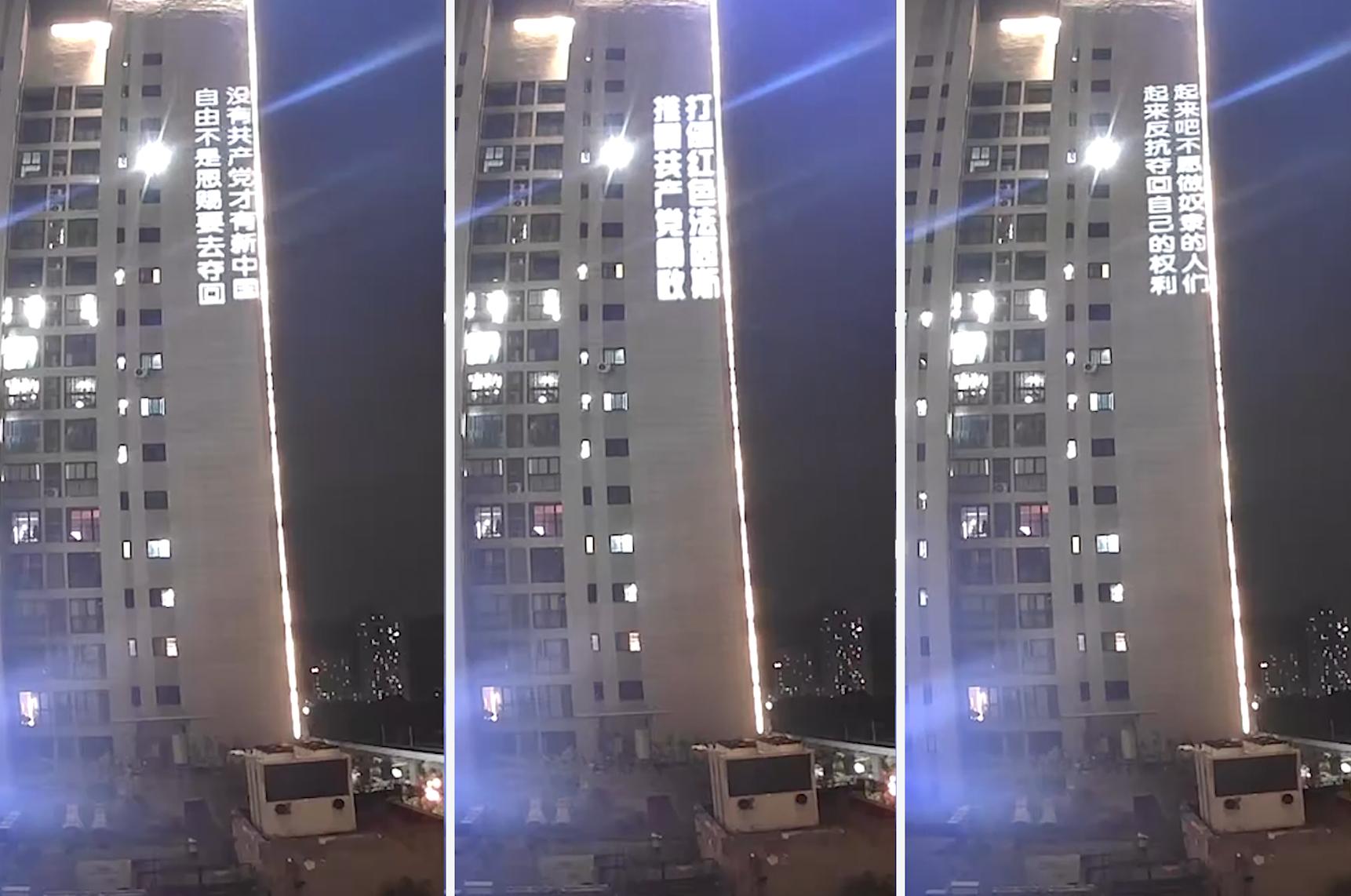
Projector Protest in Chongqing
Chongqing digital protest juxtaposes protests that are organised and involve many people, as this particular protest was planned and staged by an individual. The protest took place a few days before China’s big show of national strength on Victory Day Parade-2025 in Beijing, an anonymous act of digital dissent briefly illuminated the skyline of Chongqing. Projected onto a cluster of high-rise buildings, a sequence of Chinese characters declared: “Only without the Communist Party could there be a new China; freedom is not a gift, it must be reclaimed! Arise, ye who refuse to be slaves! Rise up and reclaim your rights! Down with red fascism! Overthrow Communist tyranny! No lies, only truth; no enslavement, only freedom! The tyrannical Communist Party, step down!” These words bore striking resemblance to the rhetoric of China’s national anthem, “March of the Volunteers,” the opening line of the anthem, “arise, ye who refuse to be slaves”, has long been associated with revolutionary mobilisation. This intertextual echo was not incidental. The meticulously selected phrases shone on the sky scrappers for fifty minutes, gained greater emotional resonance and mnemonic power. The linguistic rhythm rooted in a national symbol and projected in 国家中心城市(guójiā zhōngxīn chéngshì):National central cities, a place of national significance made the message indelible and resonating, this strategic appropriation of patriotic symbol discourse reflected a broader trend in digital protest, wherein dissenting actors repurpose official idioms to contest the very authority from which those idioms originate. The 2025 projection thus exemplifies the intensification of digital protest as a significant mode of political expression in contemporary China. The protest that was inspired by 2022, “Sitong Bridge Protest” staged by Peng Lifa, who had mounted the bridge alone and hung two big posters in the political capital garnering national and international attention, on the eve of 20th National Congress. In the twentieth party congress, President Xi secured a third term as General Secretary of the party for the third time, breaking the two term- norm that was set since the 90’s politics.
Digital Protest in China: An Evolving Landscape
With an environment marked by sophisticated censorship systems, AI assisted surveillance, and rapid content deletion, digital protest in China has undergone a pronounced transformation in the last decade. Like Qi Hong, who staged the Chongqing projector protest, citizens rely on such creative forms of protest to articulate dissent. In 2021, when China witnessed #MeToo movement, it saw that women did not directly post the words but they posted pictures of a bowl of rice written as “mi” in mandarin and a picture of a rabbit, written as “tu”. The surveillance system was unable to identify mi-tu as the sensitive content and the movement was able to gain huge traction. The Wulumuqi Street Protest in Shanghai news did not flare up because posts, videos and discussions linked to the gathering disappeared within minutes, reflecting a model of digital governance that relies on automated filtering, rapid moderation and tight coordination between platforms and local authorities. Chinese platforms operate on multilayer monitoring systems that uses automated filters to identify sensitive content through keywords, image recognition and other data. Before social media posts even gain traction they are identified, and when several users post similar content from the same location, platform algorithms flag the cluster. Human moderators then review and remove posts.
Conclusion
While China rarely has space for organised protests, digital protest has evolved into a form of dissent that is fleeting yet potent, individualised yet symbolically rich. The rise of ephemeral acts (writing posts), coded posts (mitu), and spatial acts-such as the Chongqing projection and Beijing’s Sitong bridge protest demonstrates how citizens adapt to an environment of tightening surveillance and shrinking civic space.
Such acts, rather than eliminating dissent, generate new forms of creativity. Digital protest becomes a politics of disruption, memory, and symbolism, briefly flashing resistance that taints the state’s highly managed public sphere. As China’s governance model becomes more technologically sophisticated, the imagination of its dissenters too upgrades, however the fear among the dissenters also drives some of them to take refuge in other countries; activists like Lu Pin, Qi Hong and Chen Siming.
Article by Shital Baraily