

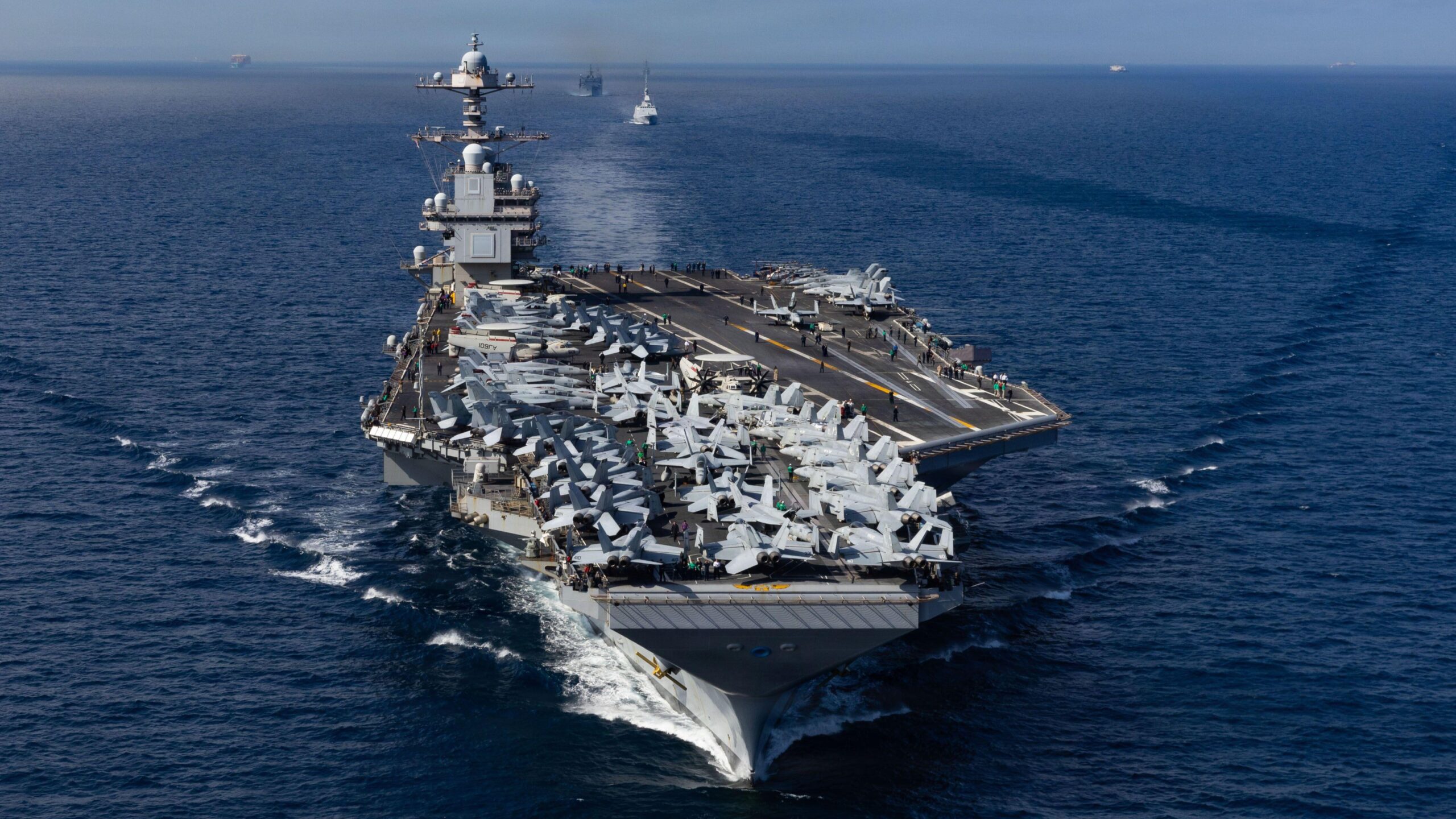
A New Cold War Mood, but a Different World
The title “Latin America’s new Cold War flashpoint” clearly indicates that the dispute between Guyana and Venezuela, especially after the deployment of a U.S. aircraft carrier, might ignite a new Cold War in this region. It is very easy to state that a World War or Cold War could take place any time soon, but turning such fears into reality is far more complicated today than it had been in the past decades. When events like Hiroshima Nagasaki or the several other Wars occurred, the world did not have as many strong international institutions as it has now. Today we have the United Nations, the International Court of Justice (ICJ) and multiple regional forums whose main objective is to prevent war-like situations.
In a world made up of many continents and nation-states, disagreements are quite natural. Like how can we even think that we are going to survive the digital era without conflicts and differences? We can understand this through a simple household example: even among relatives living under the same roof, there are disagreements, conflicts and differences of opinion, isn’t it? It is not only strangers who often fight; sometimes the deepest tensions exist within the same family. Similarly, two countries from the same continent can become deeply involved in a serious conflict. Guyana and Venezuela are both in South America, yet they are entangled in a tense dispute, which we cannot label as a full-fledged war, but surely a conflict of narratives, law, resources, power and autonomy.
The Historical Roots: How the Disputes Began?
No major international dispute begins from one single cause. It requires a series of miscommunications which ultimately leads to an international dispute. Just as we have noticed in the Iran–Iraq conflict, history plays the most pivotal role. Guyana was not always an independent country; if we track back onto the pages of History we can clearly observe that in the 1800s it was a British colony, known as ‘British Guiana’. But Venezuela has often claimed that from Spanish colonial times, the territory up to the Essequibo River belongs primarily to them. The disagreement over where the border should exist or not led to an international arbitration.
In 1899, an international arbitration tribunal in Paris granted the Essequibo region to British Guiana. At that time, Venezuela accepted this decision, without any furtherchaos. This ruling became the legal basis for Guyana’s control over Essequibo, until now. Many decades have passed without any major challenges. However, in 1949 a document surfaced provoking that the 1899 arbitral award might have been politically influenced and was biased. This revived the Venezuelan claim that the decision had been “politically unfair or wrong.” In very simple words, if we try to decipher the inner meaning then we can clearly state that Venezuela began to argue that colonial powers had manipulated the outcome and that it had been deprived of the territory that was historically its own. This led to an utter chaotic situation worldwide.
We can loosely compare this to how Kashmir is claimed by both the countries India andPakistan. Just as Kashmir lives in a state of contested identity,“Akhir Kashmir kiska hai”. Essequibo too is caught between the same battle of power and politics; does it have a legal owner or does it have a historical claimant?
The difference is that Guyana actually governs Essequibo fully today, whereas Venezuela asserts that it was cheated in the past and wants to reopen the question internationally.
In 1966, Britain awarded independence to Guyana. Once Guyana became an independent state, Venezuela renewed its claim, saying, “Essequibo belongs to us, and the earlier decision was politically unfair.”
Through the lens of Law, Power and Political biasedness
The question then automatically arises; whose legal position is much stronger? From Guyana’s side, the 1899 arbitration is recognized as international law. The Geneva Agreement, which they refer to, emphasizes that this controversy should be settled by legal and peaceful means, and not by military confrontation. Guyana says, “Let the ICJ decide; we are ready to face all legal processes.” Because legally they are on the right path.
Venezuela’s stance is quite different. It vigorously claims that the 1899 decision was fraudulent, influenced by the colonial powers of that particular time. When we use the term “politically biased” in this context, it means that a decision which should have been neutral and legal has been brutally shaped by political pressure, power relations and certain kinds of backroom influences as well. Courts are ideally expected to be the highest and most impartial authorities, but history has been a proof of this that the most powerful countries have often used their influence to bend the outcomes in their favour.
Venezuela argues that this is what exactly happened way back in 1899.Because of this belief, Venezuela rejects the ICJ’s jurisdiction on this matter and prefers to have direct negotiations with Guyana . “Direct negotiations” here simply means that it wants to talk government-to-government, outside the control of international legal bodies, and insists that the Essequibo belongs to Venezuela on prior historical grounds, and it should get back its territorial region without any further delay.
Meanwhile, Essequibo is fully under the Guyanese administration. The residents identify themselves as Guyanese; the maps, the police, and the Government all function through the official hierarchy of Guyana. On pen and paper, in daily life and in international recognition, Essequibo is part of Guyana, while Venezuela stands at a distance, saying: “It should have been ours, histories.”
Oil and the other contemporary reasons for the Conflict
Here a question arises that, ‘If this dispute has existed for so long, why has it suddenlybecome a global news and a serious geopolitical issue?’ The answer lies in a single bold word: OIL
From around 2015 onwards, massive offshore oil reserves were discovered near the Essequibo region, and this was the turning point. This instantly increased the economic and strategic value of this particular area. Guyana, once a relatively small and quiet country situated on the global map, is now on its way to becoming one of the fastest-growing economies due to oil production, and how could Venezuela leave this opportunity? . Oil means money, and tremendous power.
At the same time, Venezuela is facing severe internal crises; frequent economic collapses, inflation issues, shortages and extreme social distress. The Venezuelan leadership is acutely aware of its legal and territorial troubles. Instead of allowing the population to continuously question the government about hunger and hardship, the leadership has chosen to shift the entire narrative towards the frame of nationalism and territorial grievances: “Look at how our land has been stolen, we are hungry today because of political unfair decisions.”
Nationalism has a powerful emotional appeal almost all over the world. Whether people deeply understand the legal history or not, the idea that “our land was taken from us” can deepen strong feelings among both the educated and uneducated masses. The media then becomes a tool to further provoke this narrative. Rather than focusing on the internal mismanagement and solving it for the betterment of the public, the government has encouraged its citizens to focus on the external enemy and the old existing grievances.
Through A Cultural Lens: Hirak Rajar Deshe and Public Awareness
This strategy of manipulating public awareness is not a new thing, it has been a part of world politics. A very powerful cultural reference appears in Satyajit Ray’s film Hirak Rajar Deshe, where we get to see there is an idea that “the more people become educated, the less they will obey us.” In other words, when people are truly informed and conscious about their political rights, they are less likely to blindly follow the dictator’s authority. So, in order to maintain firm control, regimes either try to suppress education or divert the attention away from their own failures. Venezuela’s present leadership mirrors the same logic, as portrayed in Ray’s film.
Instead of inviting people to question why there is food shortage or economic collapse, it re-directs their emotional energy towards the territorial dispute over Essequibo.
The Role of Oil Companies and the External Allies
Because Essequibo is now associated with vast oil reserves, global economic factors are deeply involved. Large American companies, such as ExxonMobil, as per reports are heavily invested in Guyana’s oil fields. Guyana has a positive relationship with the United States and is aligned with Western interests, which adds to its major confidence boost. Venezuela, on the other hand, is more closely aligned with countries that often oppose U.S. dominance, such as Russia, China and Iran. However, those countries will never get into a direct military confrontation with the United States over this issue.
That’s their diplomatic move. Their support is more likely to be in the form of political backing, economic deals, or sharing certain types of intelligence and technology. Venezuela knows very well that legally, and in terms of ground control, Guyana has the stronger position. It also understands that it cannot win a direct military clash with U.S.-backed Guyana. For this reason, Venezuela pushes for political narratives, emotional appeals and potential negotiations that might secure at least some share in future oil revenues or economic arrangements.
The U.S. Carrier and the Idea of Deterrence; its impact
A key development that transfigured this regional dispute into a “flashpoint” was the arrival of a U.S. aircraft carrier and related naval forces in the Caribbean region. Officially, the United States claims that these deployments are a part of operations to counter drug trafficking and maintain regional security. But to be very honest, severalanalysts clearly state that this is a prime example of contemporary deterrence.
Deterrence does not simply mean attacking a nation; it means preventing the other side from taking a risky step by clearly displaying the future consequences. Venezuela, for its part, has placed its forces on high alert and publicly condemned this move as an imperialist provocation. It continues to paint itself as a victim whose sovereignty is being threatened and claims that its free decision-making is being constrained by foreign naval power. This narrative has been set on the mere grounds of sympathy only.
How the Case Reached the International Court of Justice?
On 29th of March 2018, Guyana formally filed a case at the International Court of Justice. The goal was crystal clear: to ask the Court to confirm that the 1899 arbitral award is valid and binding or not? The ICJ first had to decide whether it had the authority (the legal jurisdiction) to hear the case. On 18th of December 2020, the Court ruled that it did indeed have jurisdiction and would proceed to examine this dispute further and ultimately reach a conclusion.
Guyana was asking the Court to order Venezuela not to take any action that would alter the current status of the territory while the case was still being decided by the International court. On 1st of December 2023, the ICJ instructed Venezuela to refrain from changing the situation on the ground, because legally Guyana was ruling it.
As of 2025, the case is still ongoing, not pending nor wrapped but it’s in between a sling. Guyana’s written arguments and Venezuela’s responses are still under consideration.
Leadership and Governance Styles of Guyana and Venezuela: Maduro Vs. Irfaan Ali
In Guyana, President Irfaan Ali has been in office since 2020 and heads a democratic, Western-aligned government. Guyana has no interest in military escalation. It has legality on its side, growing economic prospects through oil and supportive relations with powerful states like the U.S. and other Western countries. It therefore prefers calm, law-based diplomacy rather than emotional confrontation. But on the other hand Venezuela’s leader; Maduro, is trying to play the victim card. Instead of settling the issues, he is trying to change the flow of the judgement into something which we generally term as “SYMPATHY”.
A Full-fledged War is impossible
Despite the dramatic language sometimes used in media headlines, a full-scale war between Guyana and Venezuela is extremely unlikely. Venezuela does not have the economic or military capacity to sustain such a war, especially against a country backed by the United States. Furthermore, other Latin American countries; such as Brazil, Colombia, Mexico and various Caribbean states do not want a war in their region. Because most of these countries depend heavily on tourism and stable trade routes, especially around the Caribbean Sea, which connects North and South America and is crucial for maritime commerce. Any military conflict would damage tourism, hence they would never be in favour of a full-fledged war.
Conclusion: A Cold War Flashpoint Without the possibility of having a full-fledged Hot War
The dispute over Essequibo is therefore not just a border disagreement because it is a complex mix of colonial history, international law, oil disputes, domestic politics,and regional mistrust. Guyana relies on the legal authority of the 1899 arbitration, the jurisdiction of the ICJ and the support of the United States and the other Western countries. Meanwhile Venezuela relies on its historical narrative, nationalist mobilisation and the alignment with powers that challenge U.S. influence. Basically it’s a cold war between U.S. supporters and the anti U.S. supporters.
This creates a consequence which is very similar in structure, though not in scale, to the old Cold War between the U.S. and USSR. The two blocs face each other indirectly: one which is led by the United States and the other supported, symbolically by Russia, China and Iran.
A full-fledged war is very unlikely, but a Cold War-style confrontation made up of deterrence and legal battles, and not forgetting cooking different narratives to divert the attention of the masses, is very clearly visible. Essequibo is no longer just a piece of land; it is a powerful island upon which questions of sovereignty, justice, power and survival are all being played out in front of the world.